Contact Office On
Published Progress – SDG12
Public reporting on university progress and performance related to SDG12 (Responsible Consumption and Production).
Introduction
Al-Ahliyya Amman University (AAU) is fully committed to promoting responsible consumption, sustainable production, and circular-economy practices, in alignment with SDG 12 – Responsible Consumption and Production. Through the Sustainability & International Ranking Center (SIRC) and the Facilities and Environmental Services Department, the University has developed and implemented integrated programmes focused on waste reduction, resource efficiency, and sustainable procurement.
Between 2023 and 2025, AAU made measurable progress in:- launching a Smart Recycling Programme and Waste-to-Energy Project to minimise waste generation and increase resource recovery;
- implementing a Sustainable Procurement framework that prioritises eco-friendly materials, ethical suppliers, and locally sourced products;
- integrating sustainability principles into curricula, operations, and awareness campaigns; and
- publishing all outcomes, policies, procedures, and environmental data through the AAU Sustainability Portal and Annual Sustainability and Executive Reports.
This governance-based and transparent reporting system ensures that AAU’s commitment to responsible consumption is evidence-based, verifiable, and publicly accessible, directly contributing to UN SDG 12 targets (12.2–12.8) and Jordan’s National Green Growth Plan (2021–2030).
Centers and Departments
02General Supplies and Services Department
03Finance Department
04Deanship of Student Affairs
05Hourani Center for Applied Scientific Research
06Marketing and Communications Unit
Activities
01AAU Sustainability Report 2024–2025
02Executive Sustainability Report (SDG 12 Section) 2024–2025
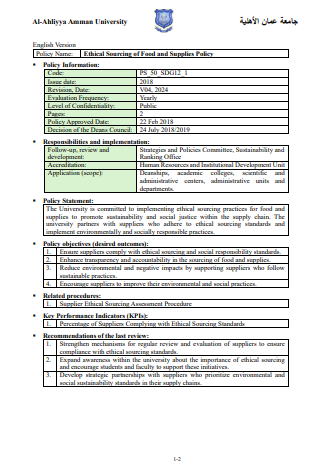
03Ethical Sourcing of Food and Supplies Policy
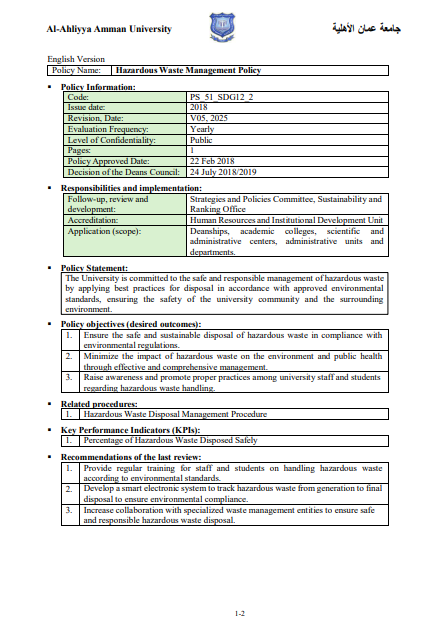
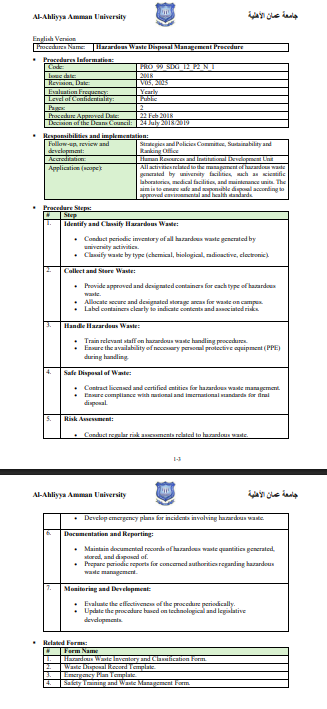
04Hazardous Waste Management Policy
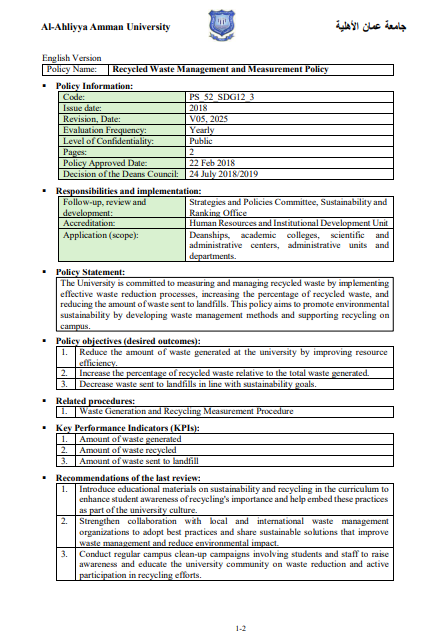
05Recycled Waste Management and Measurement Policy
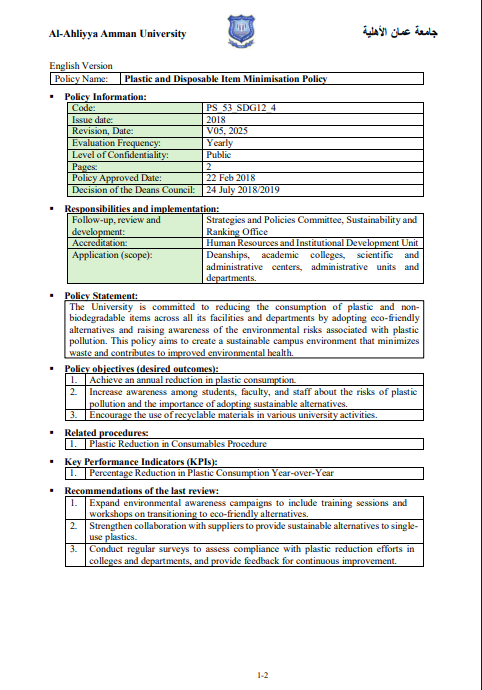
06Plastic and Disposable Item Minimisation Policy
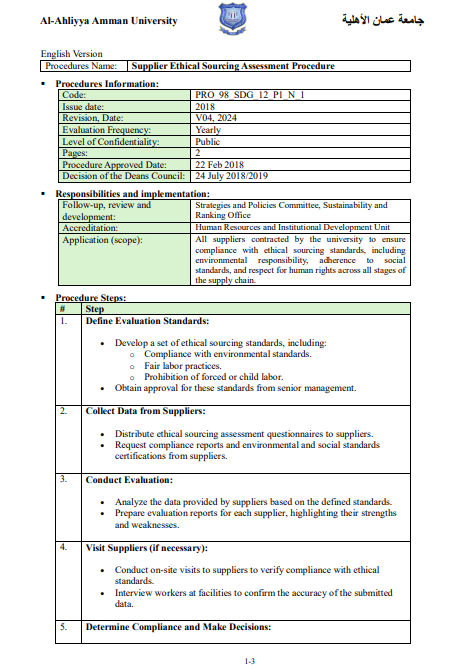
07Supplier Ethical Sourcing Assessment Procedure
08Hazardous Waste Disposal Management Procedure
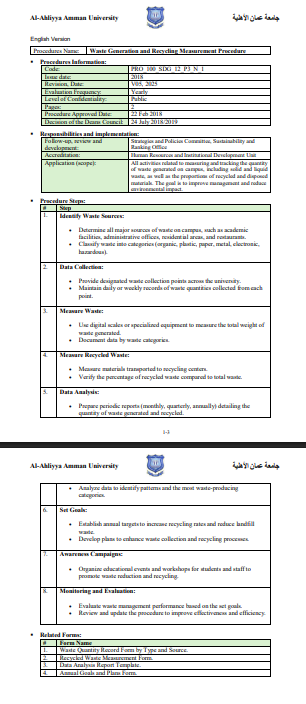
09Waste Generation and Recycling Measurement Procedure
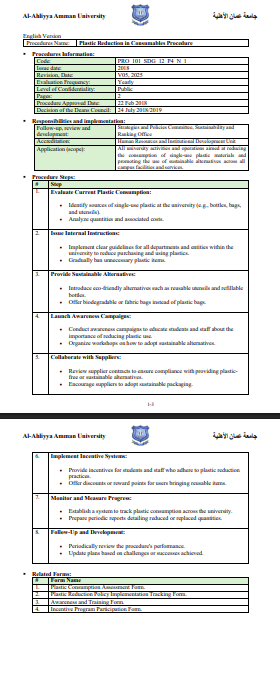
10Plastic Reduction in Consumables Procedure
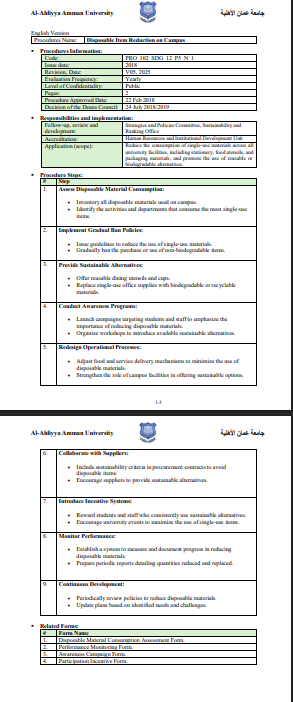
11Disposable Item Reduction on Campus Procedure
Impact Evaluation & Development Plan
Performance Evaluation
- Sustainable Resource ManagementAAU monitors material and energy consumption across all units, with particular focus on:
- total volumes of solid waste generated and recycled;
- hazardous-waste streams from laboratories and medical units;
- consumption of single-use plastics and disposable items.
- These indicators are recorded, analysed, and summarised annually in the AAU Sustainability Report 2024–2025 and the Executive Sustainability Report (SDG 12 Section).
- Smart Recycling, Waste Segregation, and Circular PracticesThe University applies a multi-stream waste-management system supported by:
- clearly labelled collection points for recyclables, hazardous waste, and general waste;
- the Smart Recycling Programme and Waste-to-Energy initiatives;
- the Recycled Waste Management and Measurement Policy and the Waste Generation and Recycling Measurement Procedure, which define responsibilities and data-collection methods.
- Sustainable Procurement FrameworkAAU has adopted a set of interlinked policies and procedures that govern responsible sourcing, including:
- Ethical Sourcing of Food and Supplies Policy;
- Plastic and Disposable Item Minimisation Policy;
- Supplier Ethical Sourcing Assessment Procedure;
- Disposable Item Reduction on Campus Procedure.
- Awareness, Capacity Building, and Student EngagementRegular workshops, training sessions, and student-led campaigns promote sustainability literacy and responsible-consumption behaviours. The Deanship of Student Affairs and student clubs act as key partners in:
- organising awareness days and campaigns on waste reduction and plastic minimisation;
- engaging students as “sustainability ambassadors”;
- documenting participation and impact for inclusion in the Sustainability Report.
- Public Transparency and Verified Reporting All SDG 12-related policies, procedures, and performance indicators are:
- compiled and verified by SIRC in coordination with the Facilities and Environmental Services Department and the Finance & Procurement Department;
- published through the AAU Sustainability Portal, the AAU Sustainability Report 2024–2025, and the Executive Sustainability Report (SDG 12 Section).
Development Actions
- Action 1: Zero-Waste Campus Initiative (2025–2028) Scale up waste reduction, recycling, and reuse across all university operations to move towards a zero-waste campus model. Target: Achieve a 90 % overall recycling and recovery rate by 2028, with progress independently verified and reported annually in the AAU Sustainability Report. Action 2: Sustainable Procurement Portal (2025–2028) Develop a digital Sustainable Procurement Portal to track and report eco-friendly purchasing across all units. The portal will also display an annual Sustainable Procurement Scorecard for each department. Target: Portal operational by 2026; all major supplier categories monitored; summary data and supplier profiles publicly accessible via the Sustainability Portal. Action 3: Circular Economy Research Fund (2025–2028) Support faculty and student research on circular-economy models, sustainable materials, waste minimisation, and life-cycle assessment. Target: Fund at least 5 applied research projects per year, with all results published in open-access format and linked to SDG 12 indicators on the Sustainability Portal. Action 4: Green Office Certification Programme (2025–2028) Introduce a Green Office Certification scheme that assesses departments on energy use, paper and plastic consumption, waste segregation, and sustainable procurement. Target: 100 % of academic and administrative units certified as “Green Offices” by 2027; certification criteria and results published online. Action 5: Awareness and Student Engagement Programme (2025–2028) Expand student engagement through campaigns, competitions, and ambassador programmes focused on responsible consumption and production. Target: At least 1,500 student participants annually; activities, outcomes, and behaviour-change indicators documented and publicly reported.
Benchmarking & Best Practice
- AAU benchmarks its SDG 12 framework against global leaders such as the University of Cambridge (UK), the University of Melbourne (Australia), and KAUST (Saudi Arabia), recognised for transparent circular-economy reporting and integrated sustainable-procurement systems. Adopted Practices include:
- applying a life-cycle approach to resource management and procurement;
- digital tracking of waste flows, recycling rates, and consumption patterns;
- open publication of sustainability metrics, policies, and performance data;
- linking operational performance with education, research, and community engagement.
- Jordan’s Green Economy Strategy;
- Waste Management Framework Law No.16 (2020);
- national climate and green-growth policies.