088.2.6

Pay Equity Policy

Policy ensuring equitable pay scales and commitment to monitor and close gender pay gaps.

Executive Summary

Al-Ahliyya Amman University (AAU) is firmly committed to pay equity and the elimination of all forms of wage discrimination through its institutional Fair and Equitable Wage Policy, which ensures equal pay for equal work across all job categories, regardless of gender, age, nationality, religion, disability, or employment status.

AAU reinforces this commitment through the Gender Pay Gap Review Procedure, which mandates systematic annual assessments of salary structures, job families, grade levels, and compensation packages to identify disparities and ensure corrective action. The Employee Rights and Pay Appeals Procedure provides transparent, accessible, and fair channels for staff to raise concerns related to pay inequity or compensation fairness.

AAU’s approach aligns with: ✔ SDG 5 (Gender Equality) ✔ SDG 8 (Decent Work and Economic Growth) ✔ SDG 10 (Reduced Inequalities) ✔ Jordanian Labour Law & Equal Opportunity Standards

Through evidence-based monitoring, transparent reporting, and inclusive employment practices, AAU demonstrates leadership in ensuring equitable pay, enhancing workforce fairness, and advancing sustainable economic prosperity.
Centers and Departments

01Human Resources and Institutional Development Unit

HR leads the implementation of the Fair and Equitable Wage Policy and conducts the annual Gender Pay Gap Review. The unit analyses salary distributions, ensures equitable pay scales, verifies gender-neutral job evaluations, and manages pay appeals in accordance with institutional policy.

02Finance Department

Ensures the financial sustainability of AAU’s equitable wage framework by integrating fair compensation standards into institutional budgeting. The department collaborates with HR to verify salary consistency, approve wage adjustments, and maintain compliance with national labour and taxation standards.

03Sustainability and International Ranking Center (SIRC)

SIRC validates pay equity data and publishes it through the AAU Sustainability Reports and Portal. The center ensures institutional transparency and alignment with international pay-equity indicators under SDG 5 and SDG 8.

04Women Health Center (WHC)

Supports women staff members through dedicated health services, equity awareness programs, and inclusive workplace initiatives reinforcing gender fairness and supporting the reduction of pay disparities.

05Global Engagement Center (GEC)

Ensures fair and equal treatment of international staff and guarantees that non-Jordanian employees benefit from the same wage-equity standards and employment protections.

Activities

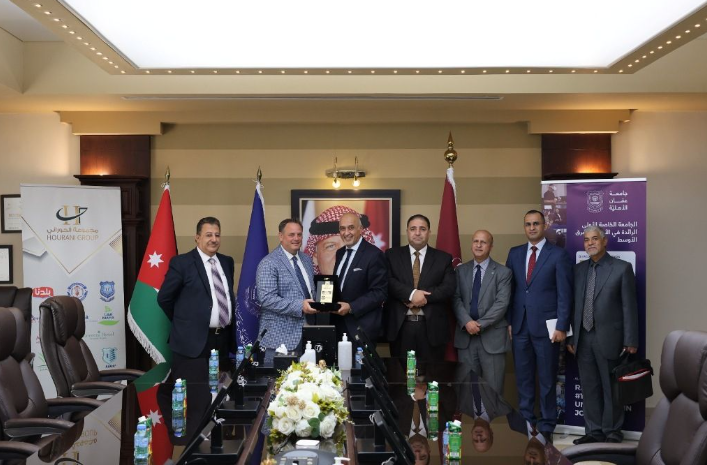
01MoU with The Human Rights Organization “Rain Collective”

This partnership reinforces AAU’s commitment to workplace fairness, gender equality, and wage justice. Workshops conducted under this MoU address equal opportunity, human dignity, workplace rights, and non-discriminatory employment practices.

02MoU with Al-Hussein Society for Training and Inclusion

Promotes equitable treatment and access to professional opportunities for individuals with disabilities – supporting inclusive employment practices aligned with gender and wage fairness.

03Crisis Management Training – Business Faculty

Training includes components on ethical leadership and equitable decision-making, promoting fair and bias-free treatment of staff during crises, workload allocations, and team management.

04Hourani e-Learning Center (HEC) – Open Equity Awareness Sessions

Provides online modules promoting workplace equality, gender fairness, human dignity, and pay transparency helping reduce inequalities through educational access.

05Center for Innovation and Entrepreneurship (CIE)

CIE offers equitable access to professional development, economic empowerment workshops, entrepreneurial training, and innovation programs without gender or demographic bias supporting pay equity through economic mobility.

Impact Evaluation & Development Plan

Performance Evaluation

  • Structured Assessment Tools
  1. AAU evaluates pay equity awareness and employment fairness through:
    • sustainability literacy surveys,
    • competency-based rubrics,
    • reflective learning assessments,
    • embedded SDG evaluation instruments.
    These tools measure knowledge of wage fairness, gender equity, labour rights, and ethical employment standards.
    • Annual Assessment Cycles
    Annual reviews monitor gender pay gaps, wage equity across job families, and effectiveness of corrective measures. Trends in pay equity and demographic wage distribution are analyzed each year.
    • Quantitative & Qualitative Indicators
    Indicators include:
    • gender-disaggregated salary analytics
    • pay transparency scores
    • wage adjustment cases
    • pay-related grievances and resolutions
    • staff perceptions of fairness
    • Integration with Curriculum
    Pay equity themes are integrated into HRM, business ethics, law, sociology, and gender studies courses. Capstone projects include analyses of wage justice, inequalities, and labour-market fairness.
    • Transparency and Public Reporting
    All findings validated by SIRC are published in:
    • AAU Sustainability Report
    • SDG 8 Executive Sustainability Report
    • AAU Sustainability Portal

    Development Actions

  2. Action 1: Annual Gender Pay Gap Audit Comprehensive salary analysis across all job categories. Target: 100% completion yearly. Action 2: Pay Equity Standard (PES) Internal standard establishing clear, gender-neutral job evaluations and compensation grading. Target: Implementation by 2026. Action 3: Pay Equity Training Program Mandatory training for department heads, HR teams, and supervisors. Target: 2025–2027. Action 4: Pay Transparency Dashboard Public dashboard showing gender-disaggregated wage equity indicators and progress. Target: Operational by 2026. Action 5: Regional Benchmarking Annual comparisons with leading universities in MENA implementing pay-equity reforms. Target: Annual published report.

    Benchmarking & Best Practice

  3. AAU benchmarks its pay-equity framework with:
    • University of British Columbia
    • University of Cambridge
    • University of Gothenburg
    Best Practices Adopted
    • transparent wage structures
    • gender-neutral job evaluations
    • annual pay-gap assessments
    • equal-opportunity promotion pathways
    • public equity dashboards
    Localization to Jordan’s Context Aligned with:
    • Fair and Equitable Wage Policy
    • Gender Pay Gap Review Procedure
    • Jordanian Labour Law
    • National Gender Equality Strategy
    Institutional Integration Summary AAU ensures the Pay Equity Policy is comprehensively embedded into HR systems, compensation structures, labour-rights monitoring, employee development, and transparent reporting. Through robust wage analyses, anti-discrimination safeguards, equal treatment standards, and international benchmarking, AAU guarantees that every employee, man or woman, Jordanian or international, receives fair, equitable, and dignified compensation. This framework advances SDG 5, SDG 8, SDG 10, and SDG 16, positioning AAU as a national leader in promoting workplace justice and wage equality. Through this structured, evidence-based approach, AAU ensures that every graduate develops the competencies needed to promote sustainability, responsible citizenship, and long-term societal resilience advancing SDG 4, SDG 12, and SDG 17.
View the 2026 edition of this pageRES.AM_ V.01_29 Oct 2026

Contact Office On

  • Email: sdo@ammanu.edu.jo
  • Phone: +962 5 3500211
  • Extension: 2060
  • Address: Al-Ahliyya Amman University / Amman-Jordan- Al Salt Road / Zip-Code (Postal Address): (19328)
  • Fax: +962 6 5336104

Al-Ahliyya Amman University

Email: Public@ammanu.edu.jo


© Copyright Al-Ahliyya Amman University. Amman, Jordan 19111.