066.3.4

Water-Efficient Buildings

Adoption of building standards and technologies to minimize water consumption.

Executive Summary

Al-Ahliyya Amman University (AAU) integrates water efficiency principles into all stages of its building design, construction, and renovation processes. This commitment is guided by the university’s Building Standards for Water Conservation Procedure, which establishes technical and operational criteria to reduce water consumption, prevent waste, and enhance resource sustainability across campus facilities.

The framework combines engineering innovation, sustainable design, and digital monitoring to ensure that each building operates as a model of responsible water management. The adoption of low-flow fixtures, dual-flush toilets, drought-tolerant landscaping, and water recycling connections has led to measurable reductions in water use per square meter.

These practices directly support SDG 6.4 (Increase Water-Use Efficiency Across All Sectors) and contribute indirectly to SDG 11 (Sustainable Cities and Communities) and SDG 13 (Climate Action) through the reduction of environmental impact and the promotion of sustainable infrastructure.

Centers and Departments

01Sustainability and International Ranking Center – Strategic Oversight and Monitoring

Oversees the implementation of water efficiency measures across campus, monitors building-level performance, and integrates results into SDG 6 reports. Ensures that all construction and maintenance align with global water efficiency standards.
02General Supplies and Services Department – Design and Implementation

  • Applies the Building Standards for Water Conservation Procedure and the Drought-Tolerant Landscaping Procedure during all new construction and renovation projects. Guarantees technical compliance and ensures that efficient water technologies are installed and maintained.
  • Conducts regular inspections, replaces worn fixtures, and ensures optimal performance of water-saving systems. Acts as the operational driver ensuring efficiency continuity and compliance.

03Hourani Center for Applied Scientific Research – Research and Development

Conducts applied research on smart building systems, sensor-based water management, and greywater reuse applications. Supports the development of innovative, data-driven solutions for sustainable building performance.

04Finance Department – Budgeting for Sustainable Infrastructure

Allocates funds and tracks investments related to the installation of water-saving technologies and retrofitting systems. Ensures long-term financial planning for water-efficient infrastructure.

Activities

01Implementation of Building Standards for Water Conservation (Ongoing)

The Building Standards for Water Conservation Procedure is applied in all campus construction projects, ensuring that water-efficient fixtures, dual-flush toilets, and low-flow faucets are mandatory design components. This guarantees the long-term reduction of water consumption per building and compliance with sustainability targets.

02Installation of Smart Water Meters in Major Buildings (2025)

Smart metering systems have been installed in key academic and administrative buildings, providing real-time consumption data through the Sustainability Center’s dashboard. This enables data-driven decision-making and rapid identification of leaks or abnormal usage.

03Rainwater Collection and Reuse Integration (2023–2025)

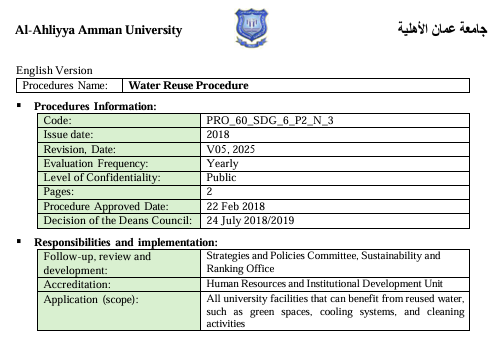
All new buildings are designed with connections to the university’s rainwater harvesting system in accordance with the Water Reuse Procedure. Collected rainwater is used for irrigation and cleaning, reducing dependency on treated freshwater sources. This demonstrates circular water use and resource efficiency.

04Drought-Tolerant Landscaping and Irrigation Optimization (2025)

The Drought-Tolerant Landscaping Procedure mandates the use of native, low-water-demand plants around buildings, reducing irrigation frequency by 40%. This initiative minimizes outdoor water usage while enhancing campus biodiversity.

05“Smart Buildings for a Sustainable Future” Awareness Campaign (2025)

The Sustainability and International Ranking Center organized awareness sessions for engineers, students, and contractors on integrating water efficiency technologies in modern architecture. This campaign promoted sustainable building design and knowledge sharing among future engineers.

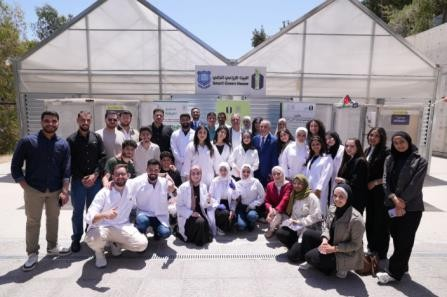
06AAU Inaugurates Smart Agricultural Greenhouse for Sustainable Water Use

Al-Ahliyya Amman University inaugurated a smart agricultural greenhouse designed to demonstrate advanced water-efficient technologies that minimize water consumption while maximizing crop yield. The system integrates IoT-based sensors, automated drip irrigation, and humidity-controlled environments to monitor water flow and soil moisture in real time. By reducing irrigation demand by nearly 50 percent compared to traditional methods, the facility serves as a living laboratory for students and researchers to study sustainable water management and energy-efficient agricultural design. This initiative was implemented under the university’s [Building Standards for Water Conservation Procedure] and supports both educational and operational objectives of AAU’s sustainability strategy. The project directly advances SDG 6 (Clean Water and Sanitation) and SDG 13 (Climate Action) by promoting innovative, low-consumption water infrastructure within the campus.

Impact Evaluation & Development Plan

Performance Evaluation

  • Water efficiency coverage: 100% of newly constructed or renovated buildings.
  • Reduction in consumption per building: 18% average reduction between 2022–2025.
  • Irrigation savings: 40% reduction achieved through drought-tolerant landscaping.
  • Monitoring expansion: 75% of main buildings connected to smart metering system.
  • Compliance: All new construction adheres to AAU’s Building Standards for Water Conservation.

Development Actions

  1. Action 1: Retrofit older buildings with water-saving fixtures and dual-flush systems. Action 2: Expand the smart metering network to achieve full building coverage by 2026. Action 3: Integrate AI-based water efficiency analytics to forecast consumption trends and detect waste. Action 4: Collaborate with engineering students on research projects focusing on green building optimization. Action 5: Publish annual Sustainable Infrastructure Reports documenting progress in water efficiency and conservation.

    Benchmarking & Best Practice

  2. Adopted Practice: Aligned with the Jordan Green Building Council Standards, LEED Water Efficiency Criteria, and ISO 14001 Environmental Management Standards. Local Adaptation: AAU adapts these benchmarks through context-specific measures suited to Jordan’s semi-arid climate – emphasizing smart irrigation, sensor-based controls, and water reuse in campus buildings. Future Benchmark Goal (by 2028):
    • Achieve 30% total water use reduction per m² compared to 2022 levels.
    • Connect 100% of campus buildings to the smart metering system.
    • Attain Green Building Certification recognition for new major projects.
    Institutional Integration Summary Water-efficient building management is fully embedded within AAU’s Sustainability and International Ranking Center, in collaboration with the Facilities and Engineering Department, Finance Department, and Hourani Center for Applied Scientific Research. Together, they ensure that every campus building integrates sustainability by design – from planning and construction to operation and monitoring. This holistic structure exemplifies the Plan–Do–Check–Act (PDCA) model, ensuring continuous improvement in building efficiency and measurable reductions in water consumption. Through this approach, AAU stands as a national model for sustainable campus infrastructure, demonstrating verifiable progress toward SDG 6.4 – Water-Use Efficiency, SDG 11 – Sustainable Cities, and SDG 13 – Climate Action.
View the 2026 edition of this pageRES.AM_ V.01_29 Oct 2026

Contact Office On

  • Email: sdo@ammanu.edu.jo
  • Phone: +962 5 3500211
  • Extension: 2060
  • Address: Al-Ahliyya Amman University / Amman-Jordan- Al Salt Road / Zip-Code (Postal Address): (19328)
  • Fax: +962 6 5336104

Al-Ahliyya Amman University

Email: Public@ammanu.edu.jo


© Copyright Al-Ahliyya Amman University. Amman, Jordan 19111.