1717.4.4

Sustainability Literacy Assessment

Measurement and evaluation of students’ sustainability literacy and understanding of the SDGs.

Executive Summary

Al-Ahliyya Amman University (AAU) recognizes that meaningful progress toward sustainable development requires students to develop a deep and measurable understanding of sustainability principles and the United Nations Sustainable Development Goals (SDGs). To achieve this, the University has implemented a comprehensive Sustainability Literacy Assessment (SLA) framework that evaluates students’ sustainability knowledge, critical thinking, ethical awareness, and real-life application of SDG concepts.

The SLA system developed and supervised by the Sustainability & International Ranking Center (SIRC) in collaboration with the Teaching and Learning Center (TLC) is integrated within AAU’s academic, co-curricular, and community-learning environment.

Between 2023 and 2025, AAU implemented multiple sustainability literacy assessments across faculties, including survey-based assessments, capstone evaluations, community-course reflections, and competency-based measures. The outcomes are used to:

  • monitor student progress in sustainability knowledge and values,
  • inform curriculum improvement and teaching strategies,
  • align academic programs with global sustainability education standards, and
  • publicly report results through the AAU Sustainability Portal and Annual Sustainability Report.

This framework directly advances SDG 4.7 (Education for Sustainable Development) and SDG 17.19 (Capacity for data, monitoring, and reporting).

teaches sustainability but also measures its real impact on learners.

Centers and Departments

01Sustainability and International Ranking Center (SIRC)

Designs, implements, and reports literacy assessments. Collects and analyzes sustainability knowledge data.

02Teaching and Learning Center

Supports assessment development and faculty training. Integrates literacy evaluation into course structures.

03Deanship of Scientific Research and Graduate Studies

Incorporates literacy assessment into research and theses. Ensures sustainability competencies in postgraduate studies.

04Deanship of Student Affairs

Coordinates surveys and awareness programs among students. Promotes student participation in literacy assessment initiatives.

05Hourani E-Learning Center (HEC)

Hosts online literacy surveys and SDG learning modules. Facilitates digital data collection and analysis.

Activities

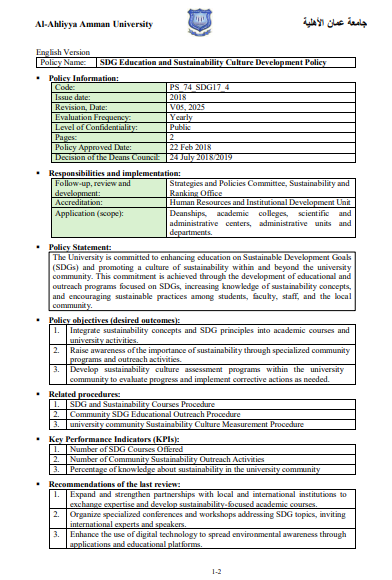
01SDG Education and Sustainability Culture Development Policy

AAU’s SDG Education and Sustainability Culture Development Policy provides the institutional foundation for integrating sustainability principles and SDG literacy into all academic programs. It ensures that all faculties adopt sustainability-focused outcomes and promote environmental and social awareness among students.

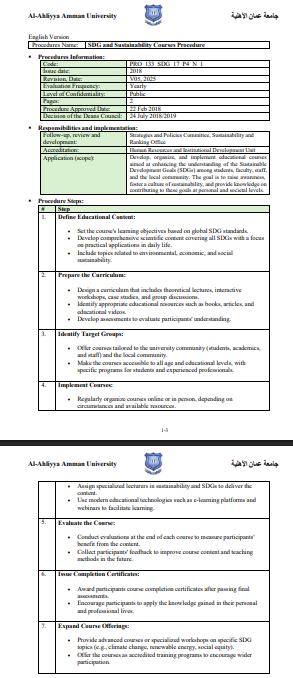
02SDG and Sustainability Courses Procedure

The SDG and Sustainability Courses Procedure outlines the process for developing, approving, and assessing SDG-based courses. It ensures that sustainability learning outcomes are measurable, aligned with the UN SDGs, and regularly evaluated through student performance and feedback.

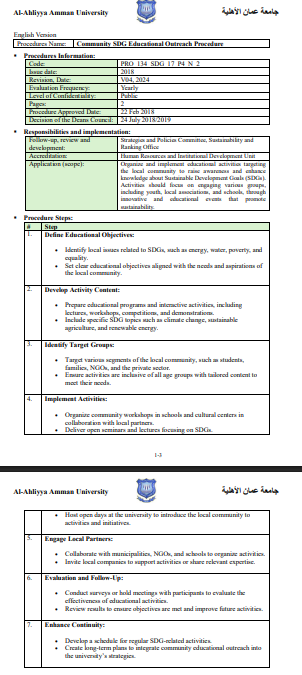
03Community SDG Educational Outreach Procedure

This procedure establishes a mechanism for linking academic learning with community engagement, allowing students to apply sustainability knowledge through workshops, volunteering, and awareness campaigns. It ensures literacy is not limited to theory but extended to practical, social impact activities bridging education and community development.

04Sustainability Literacy and Engagement Policy

AAU’s Sustainability Literacy and Engagement Policy establishes the framework for measuring and enhancing student sustainability literacy and awareness of the SDGs. It defines the methodology for data collection, analysis, and reporting to track progress in student understanding.

05University-Wide Sustainability Literacy Survey (2024)

AAU implemented a comprehensive Sustainability Literacy Survey across all faculties to assess student awareness, understanding, and attitudes toward the SDGs. The survey results are analyzed by the Sustainability and International Ranking Center (SIRC) to guide curriculum improvement and outreach programs.

06Integration of Literacy Assessment in Capstone and Community Courses

Faculty members integrate sustainability literacy assessment into senior projects, internships, and community-based courses. Students demonstrate their understanding of SDG principles through applied research, social innovation projects, and real-world solutions.

07Annual Sustainability Report 2024–2025

The AAU Sustainability Report 2024–2025 publicly presents the results of sustainability literacy surveys, assessment outcomes, and pedagogical improvements. This transparent reporting fulfills SDG 17.19 (data accountability and monitoring) and reflects AAU’s commitment to continuous learning and transparency.

Impact Evaluation & Development Plan

A.Performance

Evaluation

1. Structured Assessment Tools

  • AAU uses a combination of:
    • standardized sustainability literacy surveys,
    • competency-based rubrics,
    • reflective learning assessments,
    • and course-embedded evaluation instruments to measure student understanding of sustainability and SDG principles.
    These tools include questions on environmental responsibility, social inclusion, ethical decision-making, climate awareness, circular economy, and community engagement.

    2. Annual Assessment Cycles

    Sustainability literacy is measured every academic year across undergraduate and postgraduate levels. Annual assessments capture trends in awareness, behavioral change, and SDG competency development.

    3.Quantitative & Qualitative Indicators

    The assessment framework collects:
    • multiple-choice and scenario-based data (knowledge),
    • Likert-scale indicators (attitudes and values),
    • and open-ended reflections (critical thinking and application).
    This provides a holistic picture of student sustainability literacy.

    4. Integration with Curriculum

    SLA outcomes are directly used to:
    • improve sustainability course content,
    • strengthen SDG learning outcomes across all faculties,
    • support faculty training on sustainability pedagogy.
    Capstone and community-engaged courses now include mandatory SDG-related assessment components.

    5. Transparency and Public Reporting

    All assessment findings are:
    • validated by SIRC,
    • reported to university leadership,
    • and published in the AAU Sustainability Report 2024–2025, Executive Sustainability Report, and AAU Sustainability Portal, ensuring full transparency.
B

Development Actions

  • Action 1: University-Wide Sustainability Literacy Survey

Conduct a mandatory annual literacy survey for all undergraduate students. Target: ≥ 70% participation rate per academic year.

  • Action 2: Sustainability Competency Rubric

Develop and implement a structured rubric measuring knowledge, skills, values, and behaviors aligned with SDGs. Target: Full implementation by 2026.

  • Action 3: Capstone Course Integration

Embed sustainability competency assessment into final-year and graduation projects across all faculties. Target: 100% integration by 2027.

  • Action 4: Data Dashboard & Public Reporting System

Launch a digital dashboard visualizing literacy performance trends and comparative metrics. Target: Operational by 2026.

  • Action 5: Regional Benchmarking

Benchmark AAU’s literacy results annually against other universities in the MENA region. Target: Annual published benchmarking report.

C

Benchmarking & Best Practice

AAU benchmarks its sustainability literacy framework against leading institutions including:

  • University of British Columbia (Canada),
  • University of Cambridge (UK),
  • University of Gothenburg (Sweden),

all recognized for advanced sustainability learning assessment models.

Adopted Best Practices
  • annual standardized literacy assessments,
  • integration of SDG assessment components in course evaluations,
  • competency-based learning measurement,
  • visualization of sustainability learning outcomes through public dashboards.
Localization to Jordan’s Context AAU adapts these global models through the:
  • Sustainability Literacy and Engagement Policy,
  • SDG and Sustainability Courses Procedure,
  • and alignment with Jordan’s National Education Strategy 2022–2030, ensuring cultural relevance and national impact.
Future Goal (by 2028)

Establish the AAU Sustainability Competence Observatory, dedicated to measuring, benchmarking, and publicly reporting sustainability literacy levels among students, alumni, and the broader university community.

Institutional Integration Summary

At Al-Ahliyya Amman University (AAU), the Sustainability Literacy Assessment (SLA) functions as a core component of the university’s Education for Sustainable Development strategy. The system is administered and quality-assured by the Sustainability & International Ranking Center (SIRC) in collaboration with the Teaching and Learning Center (TLC).

The SLA framework includes:
  • annual literacy surveys,
  • course-embedded SDG assessments,
  • capstone evaluations,
  • qualitative reflections in community courses.

All data are aggregated, analyzed, and published through AAU’s sustainability reporting system, ensuring transparency, accountability, and continuous improvement.

Through this structured, evidence-based approach, AAU ensures that every graduate develops the competencies needed to promote sustainability, responsible citizenship, and long-term societal resilience – advancing SDG 4, SDG 12, and SDG 17.

View the 2026 edition of this pageRES.AM_ V.01_29 Oct 2026

Contact Office On

  • Email: sdo@ammanu.edu.jo
  • Phone: +962 5 3500211
  • Extension: 2060
  • Address: Al-Ahliyya Amman University / Amman-Jordan- Al Salt Road / Zip-Code (Postal Address): (19328)
  • Fax: +962 6 5336104

Al-Ahliyya Amman University

Email: Public@ammanu.edu.jo


© Copyright Al-Ahliyya Amman University. Amman, Jordan 19111.