1717.4.1

Commitment to SDG Education

Institutional commitment to meaningful education on the SDGs across all programs and disciplines.

Executive Summary

Al-Ahliyya Amman University (AAU) demonstrates a strong, strategic, and institutionalized commitment to integrating the United Nations Sustainable Development Goals (SDGs) into all levels of education, teaching, research, and student engagement.
Recognizing that sustainable development begins with education, AAU ensures that principles of sustainability, global citizenship, social responsibility, and ethical leadership are embedded across all academic programs, disciplines, and experiential learning activities.

Since 2023, AAU has adopted a whole-institution transformation approach through:

  • integration of SDG-aligned learning outcomes across more than 70 academic programs,
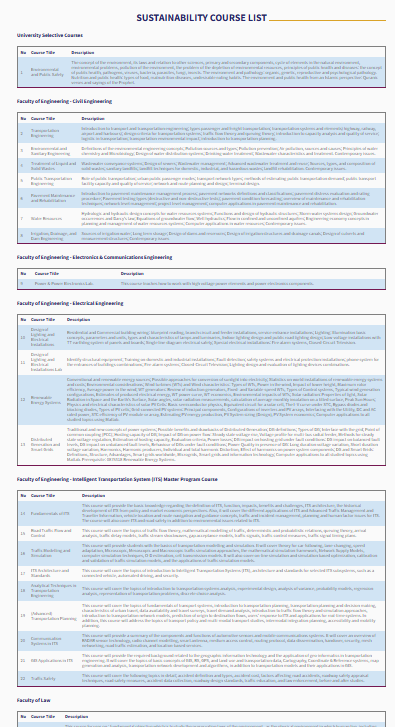
  • development of specialized sustainability and SDG-focused courses,
  • training and capacity-building for faculty on sustainability-oriented pedagogy,
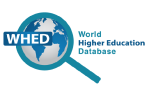
  • active student engagement through sustainability clubs, SDG Ambassadors, and community-driven projects,
  • transparent publication of all progress through the Sustainability Portal, Sustainability Report 2024–2025, and Executive Sustainability Report.

This framework aligns directly with SDG 4.7 (Education for Sustainable Development) and SDG 17.14 (Policy Coherence for Sustainable Development), and positions AAU as a regional model for embedding sustainability competencies into higher education.

Centers and Departments

01Sustainability and International Ranking Center (SIRC)

Oversees SDG curriculum integration and data reporting. Monitors progress and publishes educational sustainability reports.

02Teaching and Learning Center

Enhances faculty teaching practices and learning quality. Conducts SDG-focused pedagogy workshops and training programs.

03Deanship of Scientific Research and Graduate Studies

Supports SDG-related research and academic innovation. Promotes inclusion of sustainability in research and postgraduate studies.

04Deanship of Student Affairs

Engages students in sustainability leadership and volunteer programs. Coordinates the Student SDG Ambassadors Program.

05Hourani e-Learning Center

Integrates sustainability content in digital and blended learning platforms. Ensures SDG content accessibility through digital curricula.

Activities

01AU Sustainability Report 2024–2025

The Sustainability Report 2024–2025 documents AAU’s comprehensive integration of SDG education into its curriculum, training programs, and community outreach activities. It highlights measurable outcomes in student engagement and interdisciplinary learning.

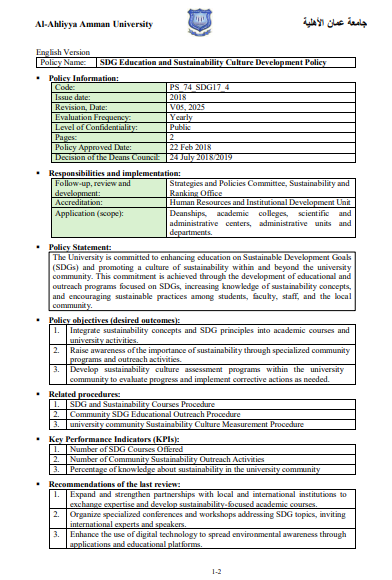
02SDG Education and Sustainability Culture Development Policy

AAU officially adopted the SDG Education and Sustainability Culture Development Policy, which mandates the integration of sustainability concepts into all academic programs and encourages interdisciplinary approaches. This policy reinforces SDG 4.7 and institutionalizes sustainability learning across faculties.

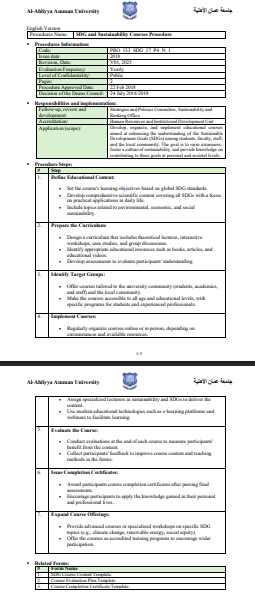
03SDG and Sustainability Courses Procedure

The SDG and Sustainability Courses Procedure establishes mechanisms for designing, evaluating, and monitoring SDG-related courses across all faculties. It ensures systematic integration of sustainability outcomes within academic programs, aligning with SDG 4.7

04Integration of SDG Education Across 70 Academic Programs

AAU has integrated sustainability principles and SDG learning outcomes across 70 academic programs, promoting global citizenship, ethics, and responsible innovation. This achievement directly supports SDG 4.7 (sustainability education) and SDG 17.14 (policy coherence).

05Sustainability and International Ranking Center Workshops on Sustainability Pedagogy

AAU organizes continuous training workshops for academic staff to build capacity in sustainability education, curriculum design, and assessment methods. These workshops ensure that SDG concepts are delivered effectively within all teaching disciplines.

06SDG Ambassadors Student Initiative

AAU’s Student SDG Ambassadors Initiative engages students from diverse faculties in promoting awareness, organizing campaigns, and applying sustainability solutions on campus. This initiative fosters practical understanding of the SDGs and builds student leadership capacity.

Impact Evaluation & Development Plan

A

Performance Evaluation

1. Curriculum Integration Across All Programs

More than 70 academic programs at AAU incorporate sustainability themes, SDG literacy, and global challenges into learning outcomes, assessments, and course content. Each program aligns course objectives with relevant SDG indicators informed by the SDG and Sustainability Courses Procedure.

2. Faculty Empowerment and Pedagogical Innovation

The Sustainability & International Ranking Center (SIRC), in collaboration with the Teaching & Learning Center, provides ongoing faculty training in:

  • SDG-based curriculum design sustainability pedagogy interdisciplinary teaching approaches real-world problem-solving methodologies

These efforts ensure that SDG education is integrated consistently and effectively across disciplines.

3. Student Engagement and SDG Leadership

Through initiatives such as the SDG Ambassadors Program, sustainability clubs, innovation challenges, and research competitions, students:

  • engage in applied sustainability projects, participate in awareness campaigns, develop SDG-focused research and community solutions, act as peer educators promoting sustainability literacy.

This strengthens students’ leadership, innovation, and civic responsibility.

4. Policies Supporting SDG Education AAU’s institutional commitment is formalized through:
  • SDG Education and Sustainability Culture Development Policy, and SDG and Sustainability Courses Procedure

These documents ensure that sustainability principles are embedded structurally into curriculum development, course approval, and teaching practices.

5. Data Collection and Public Reporting The Sustainability & International Ranking Center (SIRC) tracks:
  • the number of SDG-integrated courses and programs; faculty participation in sustainability training; student involvement in SDG initiatives; learning outcomes linked to SDG competencies.
All verified data are publicly published through:
  • AAU Sustainability Report 2024–2025, Executive Sustainability Report, AAU Sustainability Portal.

This ensures transparency, accountability, and full alignment with THE Impact Ranking evidence requirements.

B

Development Actions

  • Action 1: SDG Curriculum Mapping Project

Map every course learning outcome to specific SDGs and integrate measurable indicators. Target: 100% alignment by 2026; results published publicly.

  • Action 2: Sustainability Pedagogy Training Program

Deliver annual training to all faculty on SDG teaching models and innovative learning strategies. Target: 100% faculty completion by 2027.

  • Action 3: SDG Education Innovation Grants

Support creative, interdisciplinary teaching projects that embed sustainability into coursework. Target: 10 grants awarded per year.

  • Action 4: AAU SDG Student Ambassadors

Train students as SDG peer educators, campus leaders, and community advocates. Target: 50 ambassadors annually; activities publicly reported.

  • Action 5: Annual SDG Education Report

Publish an annual report detailing curriculum integration, SDG learning outcomes, student impact, and faculty development. Target: Annual publication through SIRC starting 2025.

C

Benchmarking & Best Practice

AAU benchmarks its SDG education framework against global leaders, including:
  • University College London (UK) University of Melbourne (Australia) University of Gothenburg (Sweden)

These universities are recognized for fully integrating sustainability across curricula and institutional culture.

Adopted Best Practices:
  • curriculum-wide SDG integration, interdisciplinary teaching linking theory to real-world challenges, sustainability dashboards for tracking performance, open-access publication of results and policies.
Localization to Jordan’s Context AAU ensures that SDG education is aligned with:
  • Jordan’s National Higher Education Strategy (2022–2030), Jordan Vision 2033, national sustainability and human-capital development initiatives.

This ensures both global relevance and local impact.

Future Goal (by 2028)

Establish the AAU Center for Sustainability Education and Global Citizenship, serving as a regional hub for:

  • curriculum innovation, faculty development, student SDG leadership, international collaboration, sustainability education research.

Institutional Integration Summary

SDG education at AAU is coordinated through a multi-level governance model led by the Sustainability & International Ranking Center (SIRC) in partnership with:

  • the Teaching & Learning Center, the Deanship of Scientific Research, academic faculties, student engagement units.

Policies such as the SDG Education and Sustainability Culture Development Policy and the SDG and Sustainability Courses Procedure guide the integration of sustainability concepts into curricula, teaching methods, and extracurricular activities.

Through transparent reporting, faculty training, curriculum development, student initiatives, and public engagement, AAU embeds sustainability literacy and global citizenship as core competencies for every graduate advancing SDG 4, SDG 12.8, and SDG 17.

View the 2026 edition of this pageRES.AM_ V.01_29 Oct 2026

Contact Office On

  • Email: sdo@ammanu.edu.jo
  • Phone: +962 5 3500211
  • Extension: 2060
  • Address: Al-Ahliyya Amman University / Amman-Jordan- Al Salt Road / Zip-Code (Postal Address): (19328)
  • Fax: +962 6 5336104

Al-Ahliyya Amman University

Email: Public@ammanu.edu.jo


© Copyright Al-Ahliyya Amman University. Amman, Jordan 19111.