1717.3.15

Published Progress – SDG15

Public reporting on university progress and performance related to SDG15 (Life on Land).

Executive Summary

Al-Ahliyya Amman University (AAU) is strongly committed to advancing biodiversity protection, sustainable land management, and ecosystem restoration, in line with SDG 15 – Life on Land. Through its sustainability governance system led by the Sustainability & International Ranking Center (SIRC), AAU actively monitors and reports initiatives that promote environmental stewardship, green infrastructure, and ecosystem conservation on campus and in surrounding communities.

Between 2023 and 2025, AAU implemented and publicly reported numerous initiatives supporting afforestation, soil conservation, habitat enhancement, and wildlife awareness. These include large-scale tree-planting campaigns, such as the AAU Arbor Day Celebration and Tree Planting Initiative, the Green Corridor and Campus Greening Program, and academic and outreach activities like the Scientific Day on Combating Desertification and Drought, which address land degradation and climate-related risks.

All progress, results, and environmental data are published through the AAU Sustainability Portal, the AAU Sustainability Report 2024–2025, and the Executive Sustainability Report (SDG 15 Section) 2024–2025, ensuring full transparency and public accessibility. AAU’s approach to SDG 15 integrates academic research, operational policies, and community engagement – contributing directly to UN SDG 15 targets (15.1–15.9) and Jordan’s National Biodiversity Strategy and Action Plan (2015–2030).

Centers and Departments

01Sustainability and International Ranking Center (SIRC)

Oversees biodiversity data collection and verification. Publishes annual reports and SDG progress indicators.

02Faculty of Allied Medical Sciences

Conducts environmental and soil health research. Provides data on pollution control and ecosystem restoration.

03Faculty of Engineering

Implements green infrastructure and sustainable landscape designs. Develops and maintains the Green Corridor Project.

04Hourani Center for Applied Scientific Research

Leads studies on desertification, biodiversity, and sustainability. Shares research outcomes through the Sustainability Portal.

05Deanship of Student Affairs

Coordinates environmental clubs and student participation. Organizes Arbor Day and biodiversity awareness campaigns.

06Marketing and Communications Unit

Publicizes AAU’s environmental achievements. Ensures public access to sustainability data and reports.

Activities

01AAU Sustainability Report 2024–2025

The Sustainability Report 2024–2025 publicly presents data on tree planting, biodiversity programs, and land sustainability initiatives. It includes metrics on vegetation area expansion, ecosystem management, and reforestation programs aligned with SDG 15 targets (15.1–15.5).

02Executive Sustainability Report (SDG 15 Section) 2024–2025

The Executive Sustainability Report 2024–2025 – SDG 15 Section highlights AAU’s achievements in land restoration, biodiversity protection, and reforestation. It provides a concise overview of measurable progress, stakeholder engagement, and future development plans in line with SDG 15.1–15.9.

03AAU Arbor Day Celebration and Tree Planting Initiative

AAU celebrated Arbor Day in Al-Balqa Governorate by planting hundreds of trees to combat desertification and promote green cover. The event engaged faculty, students, and local partners, advancing SDG 15.1 (sustainable management of terrestrial ecosystems) and SDG 13.3 (climate education).

04Scientific Day on Combating Desertification and Drought

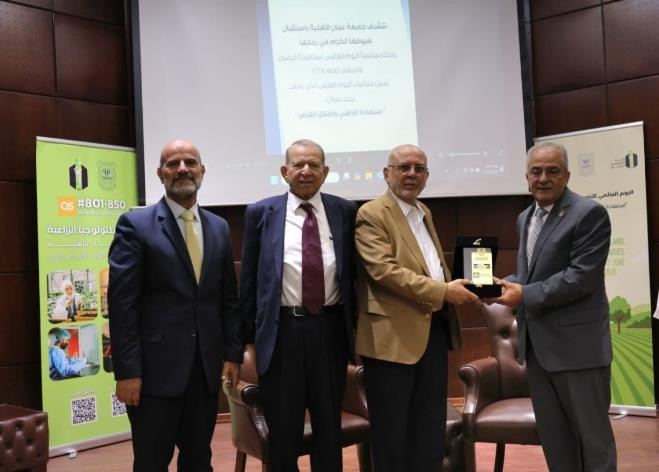
AAU organized a Scientific Day under the theme “World Day to Combat Desertification and Drought”, bringing together national experts and institutions to discuss land degradation solutions. The event supported SDG 15.3 (restore degraded land) and SDG 13.1 (strengthen resilience to climate-related hazards).

05Green Corridor and Campus Greening Program

AAU’s Green Corridor Program focuses on expanding green spaces and developing sustainable landscapes to promote biodiversity and improve air quality. The project is monitored through annual sustainability reports and contributes to SDG 15.5 (halt biodiversity

Impact Evaluation & Development Plan

A

Performance Evaluation

1. Tree-Planting and Green Campus Programme AAU has launched long-term greening projects across the campus and in neighbouring communities to increase vegetation cover, enhance shade and microclimate comfort, and support carbon sequestration.
Key initiatives include:
  • The AAU Arbor Day Celebration and Tree Planting Initiative, which engages students, staff, and local stakeholders in planting native trees;
  • The Green Corridor and Campus Greening Program, which integrates vegetation, walkable paths, and ecological connectivity into campus planning.

These efforts contribute to improving local biodiversity, mitigating urban heat, and supporting SDG 15.1 and 15.3 (sustainable use of terrestrial ecosystems and combating land degradation).

2. Biodiversity and Ecosystem Research
Research projects conducted by AAU academic units and research centers – including the Hourani Center for Applied Scientific Research and relevant faculties – explore:
  • land and soil degradation,
  • pollution impacts on terrestrial ecosystems,
  • sustainable land management and restoration practices.

The Scientific Day on Combating Desertification and Drought provides a public platform to share research findings and raise awareness of land degradation, desertification risks, and ecosystem resilience in Jordan.

3. Land Rehabilitation and Green Infrastructure

AAU integrates sustainable landscape design and green-infrastructure principles into campus planning, focusing on:

  • water-efficient landscaping and erosion control; green corridors and habitat-friendly spaces for birds and pollinators; environmentally sensitive design of open areas and walkways.

These actions support ecosystem balance, soil protection, and climate resilience, and are documented within AAU’s sustainability reporting framework.

4. Environmental Education and Public Awareness

AAU organises workshops, lectures, scientific days, and student-led campaigns to increase awareness of:

  • deforestation and land degradation, waste and its impact on land ecosystems, biodiversity conservation and the role of native species.

These activities are implemented through the Deanship of Student Affairs, sustainability student clubs, and academic departments, and are reported annually as part of AAU’s SDG 15 evidence.

5. Public Transparency and Reporting

All SDG 15-related data – including number of trees planted, area of green spaces, research outputs, and community activities – are compiled and verified by SIRC in collaboration with the Facilities and Environmental Services Department and relevant research centers. The results are published through:

  • the AAU Sustainability Report 2024–2025,
  • the Executive Sustainability Report (SDG 15 Section) 2024–2025, and
  • the AAU Sustainability Portal.

This ensures that AAU’s land and biodiversity initiatives are evidence-based, externally verifiable, and publicly transparent.

B

Development Actions

  • Action 1: AAU Green Corridor Project (2025–2028) Expand green zones, native tree planting, and habitat-friendly landscaping across campus to enhance biodiversity, shade, and ecological connectivity. Target: 2,000 new native trees planted by 2027; progress reported annually through the Sustainability Portal and Sustainability Report.
  • Action 2: Biodiversity Research Hub (2025–2028) Establish a dedicated Biodiversity Research Hub focusing on soil health, plant diversity, ecosystem services, and land rehabilitation in arid and semi-arid environments. Target: At least 5 new research projects annually; all major outputs published in open-access format and linked to SDG 15 indicators.
  • Action 3: Community Reforestation Partnership (2025–2028) Collaborate with local municipalities, governorates, and environmental NGOs on forest and park rehabilitation projects in Jordan. Target: At least 3 regional reforestation partnerships by 2026; joint activities and results documented as public case studies.
  • Action 4: Habitat and Pollinator Protection Initiative (2025–2028) Create and maintain safe habitats for birds, bees, and native plant species through pollinator-friendly gardens, nesting areas, and reduced pesticide use. Target: Development of a campus Biodiversity Index by 2027, updated annually and published on the Sustainability Portal.
  • Action 5: Climate-Resilient Landscape Development (2025–2028) Promote water-efficient landscaping, soil-conservation measures, and erosion-control techniques across campus and associated sites. Target: 30 % reduction in irrigation water use by 2028 (relative to a 2023 baseline), with performance indicators reported publicly.
C

Benchmarking & Best Practice

AAU benchmarks its biodiversity and land-sustainability initiatives against leading universities such as:

  • the University of Oxford (UK),
  • the University of Melbourne (Australia), and
  • KAUST (Saudi Arabia),

all recognized for integrating biodiversity conservation, green infrastructure, and public transparency into institutional operations.

Adopted Practices include:
  • Annual publication of biodiversity, greening, and land-restoration metrics;
  • Integration of land-sustainability principles into infrastructure design and campus development;
  • Open access to environmental reports, policies, and performance data;
  • Linking operational actions to education, research, and community engagement.

Localization to Jordan’s Context AAU aligns its biodiversity and greening practices with:

  • Jordan’s National Biodiversity Strategy and Action Plan (2015–2030);
  • the Ministry of Environment’s Green Growth Plan (2021–2030);
  • national climate-resilience and land-degradation neutrality goals.

This ensures that global best practices are translated into context-appropriate measures that support Jordan’s environmental and sustainable-development priorities.

Institutional Integration Summary

At Al-Ahliyya Amman University (AAU), initiatives supporting SDG 15 – Life on Land are coordinated through an integrated governance framework led by the Sustainability & International Ranking Center (SIRC). SIRC consolidates environmental performance data from academic, operational, and community units – including:

  • green campus and tree-planting projects;
  • biodiversity and land-degradation research;
  • awareness and community outreach programmes.

The Facilities and Environmental Services Department, research centers, and related faculties provide quantitative and qualitative indicators such as the number of trees planted, total green-space area, soil-conservation measures, and participation in environmental campaigns.

All data are verified for accuracy and consistency, then reviewed by the University Presidency before being publicly released through the AAU Sustainability Portal, Annual Sustainability Reports, and Executive Summaries. This system ensures that all land and biodiversity initiatives are measurable, evidence-based, and publicly transparent, in alignment with SDG 15 targets (15.1–15.9) and SDG 17 (Partnerships for the Goals).

Through consistent reporting, education programmes, and environmental leadership, AAU demonstrates a clear institutional commitment to land sustainability, ecosystem preservation, and climate resilience, positioning itself as a national model for biodiversity protection and sustainable development.

View the 2026 edition of this pageRES.AM_ V.01_29 Oct 2026

Contact Office On

  • Email: sdo@ammanu.edu.jo
  • Phone: +962 5 3500211
  • Extension: 2060
  • Address: Al-Ahliyya Amman University / Amman-Jordan- Al Salt Road / Zip-Code (Postal Address): (19328)
  • Fax: +962 6 5336104

Al-Ahliyya Amman University

Email: Public@ammanu.edu.jo


© Copyright Al-Ahliyya Amman University. Amman, Jordan 19111.