Contact Office On
Published Progress – SDG11
Public reporting on university progress and performance related to SDG11 (Sustainable Cities and Communities).
Executive Summary
Al-Ahliyya Amman University (AAU) is deeply committed to advancing urban sustainability, cultural-heritage preservation, and resilient community development, in alignment with SDG 11 – Sustainable Cities and Communities.
Through an integrated governance structure led by the Sustainability & International Ranking Center (SIRC) and supported by the Faculty of Architecture and Design, the Deanship of Student Affairs, the Facilities and Environmental Services Department, and the Hourani Center for Applied Scientific Research, AAU ensures that all campus and community initiatives promoting sustainable urban living are systematically documented and publicly shared.
Between 2023 and 2025, AAU made measurable progress in:- expanding sustainable campus planning and green infrastructure projects;
- conducting community-based urban and environmental programs;
- engaging students and faculty in environmental awareness and volunteer campaigns; and
- publicly reporting all outcomes through the Sustainability Portal and Annual Sustainability Reports.
This approach ensures that AAU’s commitment to urban sustainability is evidence-based, externally verifiable, and publicly accessible, directly supporting UN SDG 11 targets (11.3–11.7) and Jordan’s National Urban Development Policy.
Centers and Departments
02Faculty of Architecture and Design
03General Supplies and Services Department
04Deanship of Student Affairs
05Hourani Center for Applied Scientific Research
06Marketing and Communications Unit
Activities
01AAU Sustainability Report 2024–2025
02Executive Sustainability Report (SDG 11 Section) 2024–2025
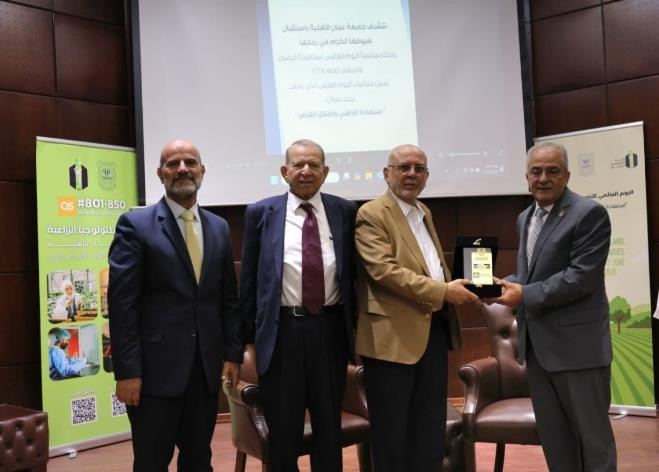
03AAU Organizes Scientific Day on Desertification and Drought
04AAU Tree Planting and Arbor Day Celebration
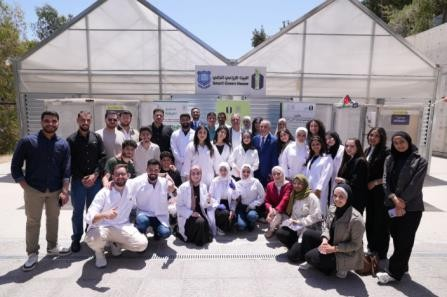
05AAU Launches the Smart Agricultural Greenhouse Project
06AAU Ramadan Charity Campaigns Supporting Local Communities
Impact Evaluation & Development Plan
Performance Evaluation
- Sustainable Campus Infrastructure and Green Spaces AAU integrates sustainable urban-planning principles across its campus through:
- the continuous enhancement of green spaces, tree planting, and shaded pedestrian areas, as reflected in activities such as the AAU Tree Planting and Arbor Day Celebration in Al-Balqa Governorate;
- the development of green and productive spaces such as the Smart Agricultural Greenhouse Project, which provides a living laboratory for sustainable agriculture, urban food resilience, and climate-adaptive design.
- These initiatives are documented in the AAU Sustainability Report 2024–2025 and the Executive Sustainability Report (SDG 11 Section), and are made publicly available through AAU’s website.
- Community-Based Environmental and Urban Awareness AAU actively promotes sustainable communities through outreach campaigns and public events, including:
- the Scientific Day on Desertification and Drought, which raises awareness about land degradation, climate impacts, and sustainable land-management practices in Jordan;
- Ramadan Charity Campaigns supporting local communities in Al-Balqa Governorate, which foster social cohesion, community solidarity, and support for vulnerable families in semi-urban and rural areas.
- Urban Research and Applied Innovation Through the Faculty of Architecture and Design and the Hourani Center for Applied Scientific Research, AAU supports applied research on:
- sustainable urban design and public-space planning;
- environmental and climate-resilient solutions for local communities;
- green infrastructure and smart-campus concepts that can be scaled to city level.
- Public Reporting and Transparency All initiatives related to SDG 11 including green infrastructure projects, environmental-awareness activities, urban-research projects, and community-outreach campaigns, are documented through AAU’s Sustainability Portal, the AAU Sustainability Report 2024–2025, and the Executive Sustainability Report (SDG 11 Section).
- evidence-based,
- externally verifiable, and
- accessible to stakeholders, in line with THE Impact Ranking requirements.
- Community Integration and Partnerships AAU collaborates with municipalities, NGOs, and local stakeholders, particularly in Al-Balqa Governorate, to promote environmentally responsible and socially inclusive community development. Such collaborations reinforce AAU’s role as a partner in building resilient, sustainable communities beyond the campus boundaries.
Development Actions
- Action 1: Smart Campus and Green Corridor Project (2025–2028) Transform the AAU campus into a model for sustainable urban design by integrating green corridors, shaded pedestrian-friendly pathways, and climate-resilient landscaping solutions. The project will incorporate elements of both tangible and intangible heritage, ensuring the preservation of local identity within the campus environment. Target: Completion of Phase II by 2026, with continuous public reporting on progress via the Sustainability Portal. Action 2: Urban Heritage Documentation Initiative (2025–2028) Digitally document Jordan’s architectural heritage, cultural landmarks, and traditional urban patterns, preserving both tangible and intangible heritage assets. The initiative will produce a digital archive accessible to researchers, students, and the public. Target: Document and archive at least 100 sites by 2027; selected outputs published online for open public access. Action 3: Sustainable Communities Research Program (2025–2028) Support faculty and student research on urban resilience, sustainable housing, green public spaces, and climate-adaptive community planning. All research outputs will be published in open-access format on the AAU Sustainability Portal to enhance public benefit and global accessibility. Target: At least 10 peer-reviewed or publicly disseminated studies published annually and linked to SDG 11 indicators. Action 4: Urban Awareness and Volunteer Program (2025–2028) Expand student and staff engagement in clean-up drives, greening activities, environmental workshops, and community-based urban improvement initiatives. Target: A minimum of 1,000 participants annually; all activities and outcomes publicly reported through the Sustainability Portal. Action 5: Community Resilience Partnership Platform (2025–2028) Establish a structured collaboration platform with municipalities, local councils, and NGOs to co-design climate-resilient, socially inclusive urban interventions. All resulting projects and research outputs will be published in open-access format on the Sustainability Portal to ensure transparency and community benefit. Target: Implement at least 5 joint projects by 2028, with publicly available case studies and impact summaries published annually.
Benchmarking & Best Practice
- AAU aligns its SDG 11 strategy with international benchmarks from:
- the University of Melbourne (Australia),
- the National University of Singapore (NUS), and
- Technische Universität Berlin (Germany),
- integrating sustainable-design principles into both academic curricula and campus infrastructure;
- open-access publication of community-engagement results and green-infrastructure projects;
- collaboration with government bodies and civil society on urban and environmental initiatives.
- Jordan Vision 2033,
- Amman Municipality’s Urban Sustainability Plan, and
- national green-growth and climate-resilience strategies.
- verified by SIRC,
- reviewed by the University Presidency, and
- approved for public release through the Sustainability Portal, the Annual Sustainability Reports, and Executive Summaries.