1616.3.1

Government Policy Advice

Provision of expert advice and policy guidance to government bodies at various levels.

Executive Summary

Al-Ahliyya Amman University (AAU) plays an expanding national role in shaping public policy and supporting governmental decision-making through expert consultation, evidence-based legal research, and structured advisory engagement with ministries, national commissions, and justice-sector institutions.
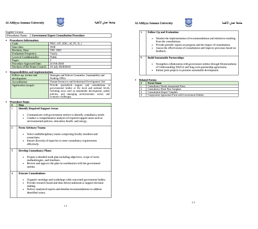
Building on its Government Collaboration Policy and the Government Expert Consultation Procedure, AAU provides:

  • authoritative research studies,
  • expert legal and policy consultations,
  • advisory seminars for government leaders,
  • platforms for legislative and judicial dialogue.

These contributions align with SDG 16.6 (effective institutions) and SDG 16.7 (inclusive decision-making), reinforcing AAU’s leadership in public-governance support.

Centers and Departments

01President’s Office

Oversees all high-level governmental engagements, coordinates official visits, establishes policy consultation pathways, and ensures alignment with national governance priorities.

02Sustainability & International Ranking Center (SIRC)

SIRC manages SDG-related government collaborations and ensures proper documentation of policy advice activities provided to national agencies.

03Faculty of Law

The Law Faculty is a primary contributor to governmental policy advice, providing expertise in legal reform, judicial practice, human rights, anti-corruption legislation, and regulatory frameworks.

04Hourani Center for Applied Scientific Research (HCASR)

Supports evidence-based policy recommendations through applied scientific research relevant to national planning, public health, and technological advancement.

05Global Engagement Center (GEC)

Facilitates international and governmental policy dialogues and strengthens cooperation with ministries, commissions, and regulatory agencies.

Activities

01Implementation of the Government Collaboration Policy

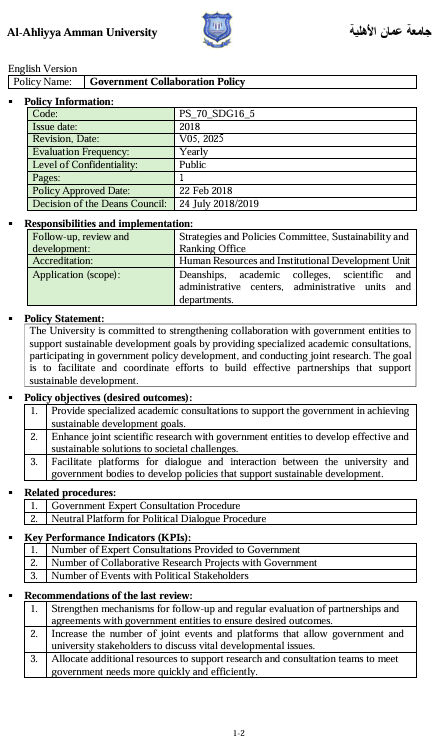
The policy provides the official framework through which AAU collaborates with ministries, commissions, and regulatory bodies, enabling structured and ongoing policy guidance.

02Application of the Government Expert Consultation Procedure

This procedure defines mechanisms for providing expert advice to government bodies, including criteria for consultation, documentation steps, and roles of academic experts involved in policy development.

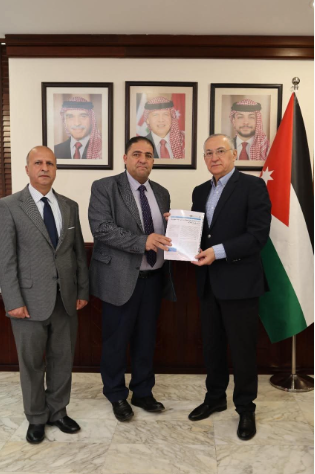
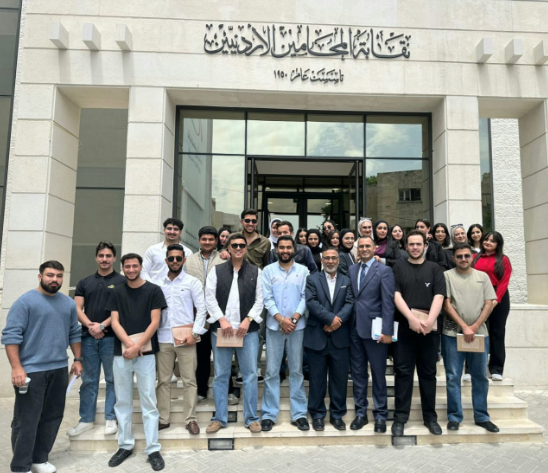
03Official Anti-Corruption Policy Advisory to the Integrity & Anti-Corruption Commission (JIACC)

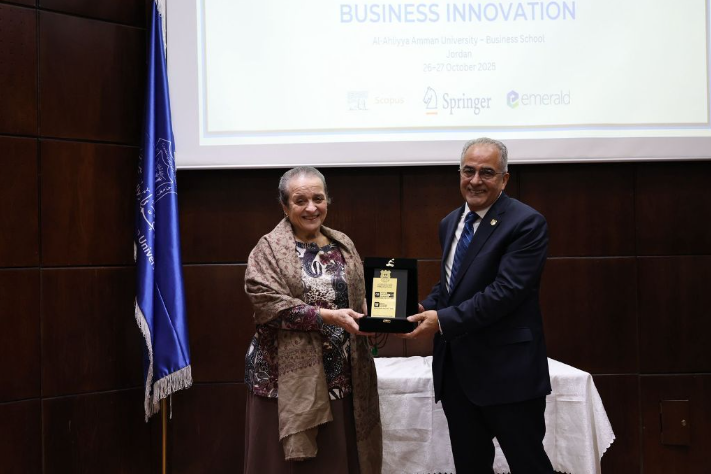
AAU delivered a major legal-policy research study titled: “Criminalizing Corruption in the Private Sector: An Analytical Study in Jordanian Legislation.” The study was formally received by:
  • Dr. Muhannad Hijazi, Chairman of JIACC
  • Dean Dr. Osayd Dhunibat, AAU Faculty of Law
The study provided:
  • legislative reform recommendations,
  • policy models for criminalizing private-sector corruption,
  • benchmarking with international conventions.
This constitutes direct high-level policy advisory to a national regulatory authority.

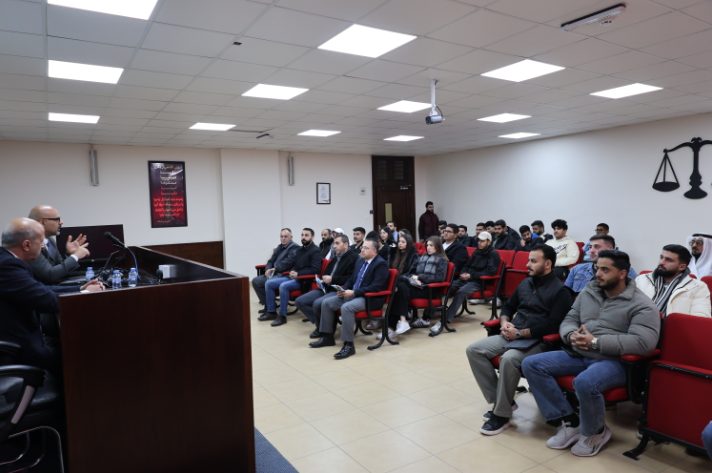
04Policy Dialogue with the Minister of State for Legal Affairs (Judicial–Arbitration Reform)

AAU hosted H.E. Dr. Fayez Al-Qudah, Minister of State for Legal Affairs, for a policy-centered seminar addressing:
  • amendments to the Jordanian Arbitration Law (2018),
  • judiciary–arbitration interactions,
  • national legislative implications,
  • alignment with international arbitration reforms.
The Minister’s participation represents direct governmental policy consultation facilitated by AAU.

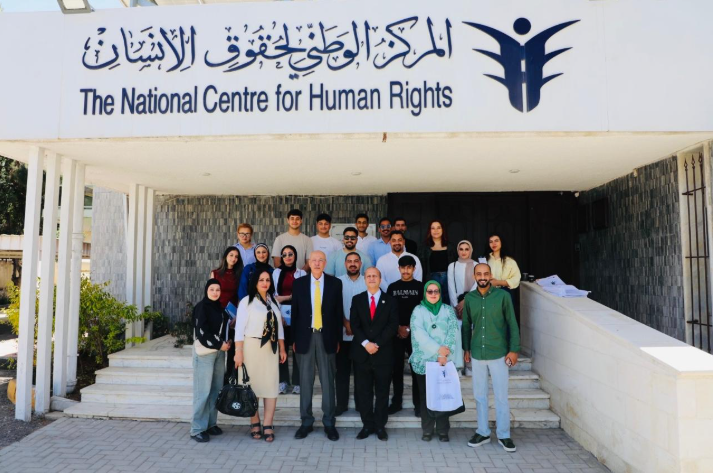
05National Human Rights Policy Consultation with the NCHR

AAU engaged with senior officials from the National Center for Human Rights, including:
  • the Commissioner General for Human Rights,
  • the Protection Commissioner,
  • the Awareness and Human Rights Culture Unit.
Discussions covered:
  • national human-rights monitoring mechanisms,
  • complaint-handling procedures,
  • treaty-compliance obligations,
  • legislative and institutional challenges.
AAU’s participation directly contributes to national human-rights policy improvement.

06Digital Governance & Legislative Development – Ministry of Digital Economy and Entrepreneurship

AAU hosted Eng. Tawfiq Abu Bakr, Director of the Personal Data Protection Directorate, who provided policy insights on:
  • drafting stages of the Personal Data Protection Law,
  • digital governance enforcement,
  • data-rights protection,
  • criminalized digital behaviors.
This session enabled AAU to participate in discussions shaping Jordan’s digital governance policies.

07Engagement with the Jordanian Bar Association & Judicial Authorities

Through structured academic–judicial interactions, AAU contributes expert perspectives on legal practice, civil procedure reforms, and justice system development.

08Institutional Governance & Digital Policy Advisory – ICDFB 2025 Conference

Under the patronage of HRH Princess Alia bint Al Hussein, AAU hosted an international conference attended by:
  • government representatives,
  • regulatory bodies,
  • institutional policymakers.
Topics included:
  • national FinTech regulation,
  • digital transformation policy,
  • institutional modernization strategies.
This positioned AAU as a leading policy-dialogue platform at the national level.

Impact Evaluation & Development Plan

Performance Evaluation

  • Policy-Relevant Research Output
  1. AAU produces directly actionable research that supports government policy development, particularly in:
    • anti-corruption legislation• arbitration and judicial reform • digital governance • human-rights policy • legal-profession governance
    • Government–Academia Consultation Mechanisms
    AAU’s consultations with JIACC, the Ministry of Legal Affairs, MODEE, and NCHR demonstrate strong alignment with national governance structures.
    • Public Governance Transparency
    All policy-advice contributions are:
    • verified by SIRC, • reviewed by university leadership, • publicly accessible through AAU’s Sustainability Portal.

    Development Actions

  2. Action 1: National Policy Advisory Council: A formal AAU-based body supporting national policy consultation. Action 2: Annual Government Consultation Summit: Bringing ministries, commissions, and AAU researchers together annually to discuss governance priorities. Action 3: Policy Insight Series (Open Access): Publishing policy briefs in anti-corruption, arbitration, digital law, and public-sector reform. Action 4: Ministry-Academic Fellowship Program: Embedding AAU researchers in governmental departments for short-term policy-development collaboration. Action 5: Digital Governance Advisory Hub: Expanding support for digital legislation, privacy, and data-protection policies.

    Benchmarking & Best Practice

  3. AAU benchmarks against global leaders in policy advisory:
    • University College London – Public Policy School • University of Melbourne – Government Relations and Law • American University of Beirut – Policy Engagement Centres • University of Cape Town – Governance & Civil Society Initiatives
    Adopted best practices include:
    • evidence-based policy consultation • multi-stakeholder dialogue platforms • public accessibility of advisory outputs • integration of academic expertise with government needs Localization to Jordan’s National Context
    AAU’s policy-advice contributions align directly with:
    • Jordan’s National Integrity and Anti-Corruption Strategy • National Digital Transformation Agenda • National Human Rights Framework • Legislative modernization priorities • Ministry of Higher Education governance guidelines
    Ensuring national needs remain central to AAU’s policy engagement.

Institutional Integration Summary

Government policy advice at AAU is coordinated across:
  • Faculty of Law• SIRC • GEC • HCASR • Legal Affairs Department
All contributions are:
  • documented, • verified, • publicly accessible, • aligned with SDG 16 (targets 16.3, 16.5, 16.6, 16.7, 16.10) and SDG 17.

This ensures AAU acts as a trusted national partner in supporting effective, transparent, and accountable governance.

View the 2026 edition of this pageRES.AM_ V.01_29 Oct 2026

Contact Office On

  • Email: sdo@ammanu.edu.jo
  • Phone: +962 5 3500211
  • Extension: 2060
  • Address: Al-Ahliyya Amman University / Amman-Jordan- Al Salt Road / Zip-Code (Postal Address): (19328)
  • Fax: +962 6 5336104

Al-Ahliyya Amman University

Email: Public@ammanu.edu.jo


© Copyright Al-Ahliyya Amman University. Amman, Jordan 19111.