Contact Office On
Union Recognition
Recognition of staff unions and representation for all employees, including women and international staff.
Introduction
Al-Ahliyya Amman University (AAU) affirms its strong institutional commitment to fair representation and the protection of labour rights through the Union and Labour Rights Recognition Procedure, which guarantees that all employees, including women, international staff, administrative teams, faculty, and outsourced workers, have the right to representation, collective dialogue, and participation in workplace decision-making.
AAU maintains an inclusive approach that encourages open communication, respects the right to organize, and ensures that employee voices are incorporated into university policies, employment frameworks, and institutional development plans. This aligns directly with SDG 8 (Decent Work and Economic Growth) and SDG 10 (Reduced Inequalities) by strengthening labour protections, promoting gender equality, safeguarding minority representation, and supporting transparent and ethical employment structures.
Through joint committees, HR consultation channels, staff representation councils, and grievance mechanisms, AAU ensures that workers’ rights are upheld and that all staff, regardless of background or identity, have equal access to advocacy, dialogue, and collective bargaining structures.
Centers and Departments
02Sustainability and International Ranking Center (SIRC)
03Finance Department
04General Supplies and Services Department
05Global Engagement Center (GEC)
06Women Health Center (WHC)
Activities
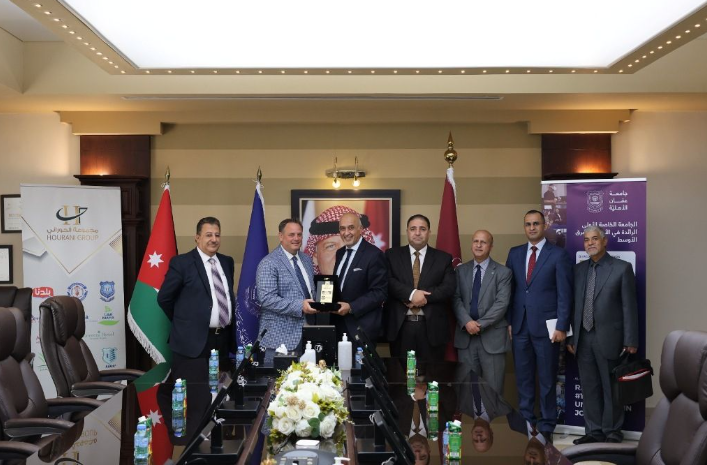
01AAU Signs a Memorandum of Understanding with The Human Rights Organization “Rain Collective”
02MoU Between Al-Ahliyya Amman University and Al-Hussein Society for Training and Inclusion
03AAU Business Faculty Participation in Advanced Crisis Management Training
04Digital Transformation Conference (ICDFB 2025) – Patronized by Princess Alia
05Global Engagement Activities Supporting International Staff Inclusion
Impact Evaluation & Development Plan
Performance Evaluation
- Structured Assessment Tools
- AAU uses standardized sustainability literacy surveys, competency-based rubrics, reflective learning assessments, and course-embedded evaluation instruments to measure student and staff understanding of SDG principles, particularly labour rights, workplace equality, and inclusive representation.
- Annual Assessment Cycles
- Quantitative & Qualitative Indicators
- scenario-based knowledge questions (labour rights & union structures),
- Likert-scale indicators (perceptions of fairness & representation),
- open-ended reflections (experiences with inclusivity, dialogue, and workplace equality).
- Integration with Curriculum
- Transparency and Public Reporting
- AAU Sustainability Report 2024–2025
- Executive Sustainability Report
- AAU Sustainability Portal
Development Actions
- Action 1: University-Wide Labour Rights Awareness Survey Annual survey measuring staff understanding of union rights and representation. Target: 70% participation rate. Action 2: Employee Representation Framework Develop a standardized representation framework ensuring equal participation of women, international staff, and outsourced workers in committees. Target: Implementation by 2026. Action 3: Union-Inclusive Training Programs Launch training modules on labour rights, anti-discrimination, and grievance mechanisms. Target: 2025–2027. Action 4: Representation & Equity Dashboard Digital dashboard publishing union participation rates, grievance outcomes, and representation distribution. Target: Operational by 2026. Action 5: Regional Benchmarking Benchmark AAU practices against leading universities in MENA. Target: Annual published report.
Benchmarking & Best Practice
- AAU benchmarks its union-recognition model against global leaders:
- University of British Columbia
- University of Cambridge
- University of Gothenburg
- labour-rights training,
- equal-opportunity representation structures,
- gender-equity mechanisms,
- public dashboards for transparency.
- Labour Rights and Non-Discrimination Policy,
- Union and Labour Rights Recognition Procedure,
- alignment with Jordan Labour Law,
- national regulations on workplace equality and collective representation.