1616.2.1

Elected Representation

Elected representation on the university’s highest governing body.

Introduction

Al-Ahliyya Amman University (AAU) ensures transparent, inclusive, and participatory governance through formally documented policies and structured representation mechanisms. The university implements two foundational documents: the University Governance Representation Policy and the University Governance Representation Selection Procedure, which establish clear criteria, nomination pathways, and selection standards for representation across governance bodies.

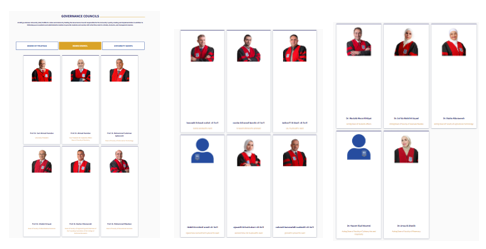
AAU’s governance system includes the Board of Trustees, the University Council, the Deans Council, and various college-level and institutional committees, all published transparently on the official governance webpage. Through these structures, the university guarantees that perspectives from different academic and administrative units are incorporated into institutional decision-making, thereby supporting SDG16.7 on inclusive and representative governance.

Centers and Departments

01Deanship of Student Affairs – Governance & Participation Support

The Deanship facilitates student participation in governance processes by coordinating the nomination and selection of student representatives according to the Governance Representation Policy. It ensures clear communication, fairness, and compliance with institutional criteria during the selection cycle.

02Human Resources Department

HR supervises the selection process for administrative staff representatives, ensuring their participation in governance committees where workplace policies, staff development, and administrative processes are discussed.

03Weekly University Leadership Meeting – President & Deans Council

The weekly leadership meeting between the University President and the Deans of all faculties serves as one of AAU’s most important governance structures. Although not a separate department, this council functions as a high-level platform where faculty views, academic priorities, and institutional needs are formally presented and discussed. Through this standing weekly meeting, the perspectives of all colleges are incorporated into decision-making processes, ensuring that academic representation is continuous, documented, and aligned with the university’s governance framework. This practice directly supports the Governance Representation Policy by creating a structured mechanism for faculty-level representation at the highest executive level.

Activities

01Implementation of the Governance Representation Policy

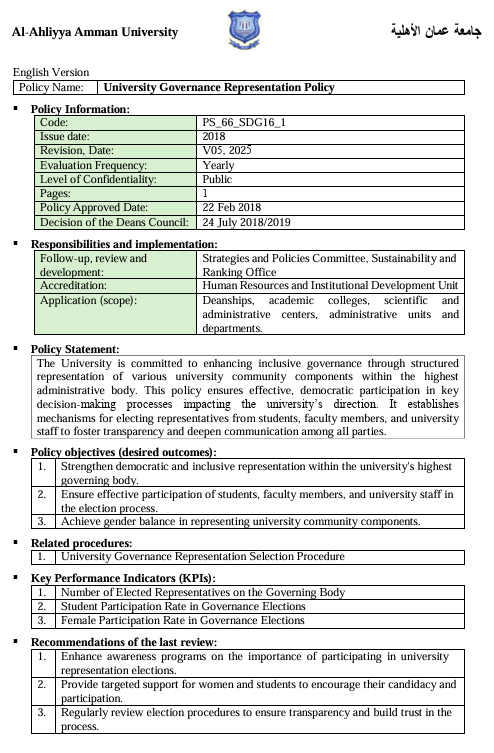
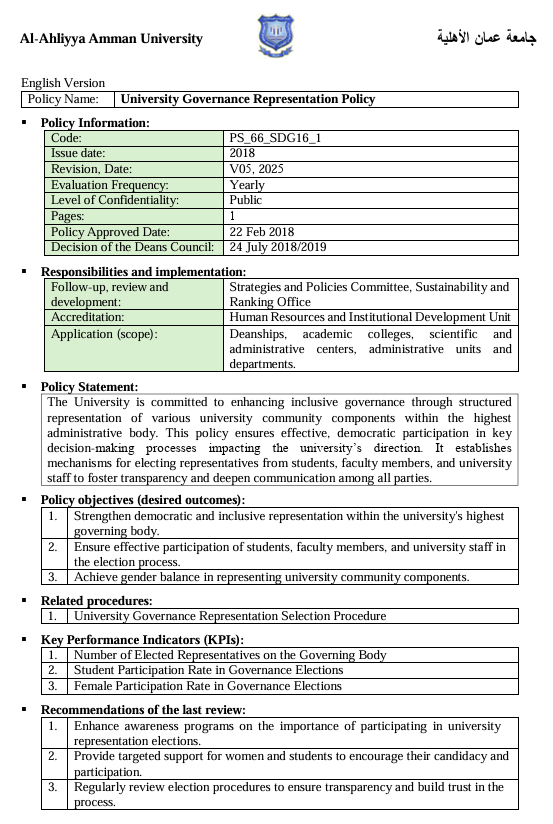
AAU applies the Governance Representation Policy as the foundational framework regulating how student, faculty, and staff representatives are identified, selected, and integrated into governance bodies. The policy ensures transparency and consistent representation across governance councils.

02Execution of the Governance Representation Selection Procedure

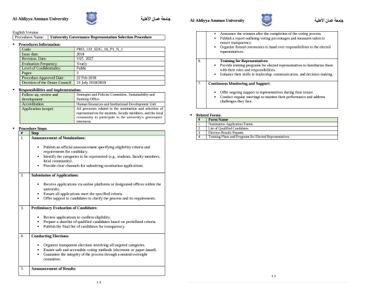
The Selection Procedure establishes a documented, step-by-step methodology for nominating and selecting representatives. It specifies eligibility conditions, selection stages, and the responsibilities of selected members, ensuring fairness and accountability.

03Participation in Official Governance Councils

AAU ensures broad representation across its highest governing bodies, including the Board of Trustees, University Council, and Deans Council. These councils incorporate academic and administrative perspectives and are publicly listed on the official governance webpage.

04Weekly President–Deans Meeting

A weekly meeting between the University President and Deans ensures ongoing academic representation in executive decision-making and strengthens feedback loops between faculties and university leadership.

05Annual Governance Review

The university conducts periodic evaluations of its governance representation mechanisms to ensure alignment with the Representation Policy and national higher education regulations.

Impact Evaluation & Development Plan

A

Performance Evaluation

  • Governance representation is formally documented and operational through approved policies and procedures.
  • The university maintains a transparent and public governance structure via its official governance webpage.
  • Representation mechanisms ensure participation from students, faculty, and administrative staff across councils and committees.
  • Weekly President–Deans meetings strengthen academic input in decision-making.
  • All representation aligns with national higher education governance expectations.
B

Development Actions

  • Action 1: Digitize the selection process for representatives to enhance transparency and accessibility.
  • Action 2: Publish an annual Governance Representation Report summarizing selected members and governance contributions.
  • Action 3: Provide training workshops on governance ethics and SDG-aligned decision-making for selected representatives.
  • Action 4: Develop a dedicated communication platform for representatives to collect input from their communities.
  • Action 5: Introduce performance evaluation indicators to measure the effectiveness of representation.
C

Benchmarking & Best Practice

Adopted Global Best Practices:

Alignment with UNESCO’s principles of institutional transparency, participatory governance, and academic representation.

Localization to Jordan’s Context:

Compliance with national governance regulations issued by the Ministry of Higher Education and Scientific Research.

Future Goal (By 2028):

AAU aims to build a fully digitized, highly transparent, and internationally benchmarked governance representation model.

Institutional Integration Summary

Governance representation is fully embedded in AAU’s institutional framework through documented policies, structured selection processes, and transparent governance councils. Through active participation mechanisms and continuous review, the university ensures that diverse perspectives inform decision-making, aligning institutional governance with SDG16 principles of transparency, accountability, and inclusive representation.

Contact Office On

  • Email: sdo@ammanu.edu.jo
  • Phone: +962 5 3500211
  • Extension: 2060
  • Address: Al-Ahliyya Amman University / Amman-Jordan- Al Salt Road / Zip-Code (Postal Address): (19328)
  • Fax: +962 6 5336104

Al-Ahliyya Amman University

Email: Public@ammanu.edu.jo


© Copyright Al-Ahliyya Amman University. Amman, Jordan 19111.