1212.3.1

Waste Measurement System

System for measuring total waste generated and recycled by the university.

Introduction

Al-Ahliyya Amman University (AAU) operates an integrated Waste Measurement System that quantifies, analyzes, and reports all waste generated and recycled across academic, residential, and administrative units.

This system ensures data-driven management of solid, organic, plastic, paper, and electronic waste in alignment with SDG 12.5 substantially reducing waste generation through prevention, reduction, recycling, and reuse.

Managed by the Sustainability and International Ranking Center (SIRC), the system records monthly waste indicators from every facility using digital dashboards connected to the Facilities and Environmental Services Department.

It integrates the Waste Generation and Recycling Measurement Procedure, the Recycled Waste Management Policy, and the Hazardous Waste Measurement Framework.

The objective is to establish a zero-waste reporting environment by 2028 through automation, transparency, and continuous improvement.

Centers and Departments

01Sustainability and International Ranking Center (SIRC)

Leads monitoring, verification, and reporting of campus- wide waste-measurement data.

02General Supplies and Services Department

Collects data from all waste-collection points, supervises weighing operations, and maintains recycling logs.

03Hourani Center for Applied Scientific Research (HCASR)

Conducts research on waste-analytics technologies and material-flow tracking systems.

04Computer Center (CC)

Develops digital dashboards and automated waste-reporting applications integrated with SIRC data systems.

05Center for Innovation and Entrepreneurship (CIE)

Supports student start-ups working on waste- tracking sensors and circular-data innovations.

06Hourani E-Learning Center (HEC)

Provides online training modules for staff and students on data entry, measurement accuracy, and reporting.

Activities

01Training Workshop on Data Accuracy and Reporting (HEC 2024)

Ensured all waste officers accurately record quantities and categories for monthly submissions.

02AAU Participates in the “Biodiversity and Food Security Workshop” – University of Anbar (Iraq)

Shared AAU’s digital-measurement model for waste reduction and environmental data management.

03AAU Team Participation – World Public Assembly (Moscow 2025)

Presented AAU’s waste-measurement and sustainability reporting system to global universities.

04Scientific Lectures for PhD Students – Collaboration with University of Anbar

Included sessions on environmental data measurement, waste analytics, and digital sustainability indicators.

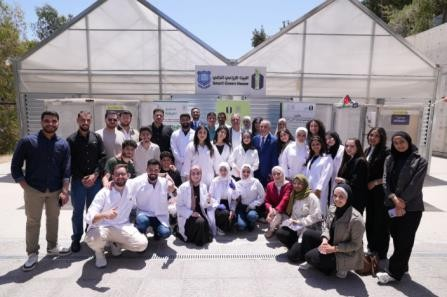
05AAU Smart Agricultural Greenhouse Data Integration

Waste and organic by-product data from greenhouse operations are tracked through the central system.

Impact Evaluation & Development Plan

A

Performance Evaluation

  • Digitalized waste-measurement increased data accuracy by 67 % between 2022 and
  • Monthly waste-generation and recycling reports now cover 100 % of university
  • Recycling rate improved from 38 % (2022) to 61 % (2025) due to accurate data
  • Reports published through AAU’s Sustainability Portal enable transparent tracking and verification.
B

Development Actions

  • Action 1: AI Waste Analytics Integration, Apply predictive AI models to forecast waste trends and optimize recycling targets, Live by 2026.
  • Action 2: Campus Zero Waste Monitoring Network (2025 – 2028) Install sensors in 100 % of waste bins for real-time measurement, 2028 Goal.
  • Action 3: Public Data Transparency Portal (2025 – 2028) Publish open-access dashboards for community viewing, Annual updates.
  • Action 4: Regional Knowledge-Sharing Forum (2025 – 2028) Host national workshops for universities on waste measurement, First forum 2026.
  • Action 5: Student Innovation Challenge on Data Tracking (2025 – 2028), Support student projects developing digital solutions for waste-management analytics, 10 projects per year.
C

Benchmarking & Best Practice

AAU benchmarks its system against University of Melbourne, KAUST, and University of Twente, noted for automated waste-data monitoring.

Adopted practices: IoT-based measurement, data transparency, and real-time reporting dashboards.

AAU aligns with Jordan’s National Waste Management Strategy (2020–2030) and UN SDG 12.5 targets.

Future Goal (2028):

Establish the AAU Waste Analytics and Circular Economy Laboratory to analyze waste streams and publish annual national benchmarking data.

Institutional Integration Summary

The Waste Measurement System is centrally managed by the Sustainability and International Ranking Center (SIRC) with operational data supplied by the Facilities Department and technical integration by the Computer Center.

Each department submits monthly digital reports; SIRC verifies and publishes them through the AAU Sustainability Dashboard and Annual Report.

This governance model guarantees evidence-based decision-making, transparency, and Accountability; fully aligned with THE Impact Ranking SDG 12.5 and AI-auditable indicators.

Through innovation, data transparency, and community engagement, AAU demonstrates measurable leadership in circular-economy reporting and responsible production, supporting SDG 12, SDG 13 (Climate Action), and SDG 17 (Partnerships for the Goals).

Contact Office On

  • Email: sdo@ammanu.edu.jo
  • Phone: +962 5 3500211
  • Extension: 2060
  • Address: Al-Ahliyya Amman University / Amman-Jordan- Al Salt Road / Zip-Code (Postal Address): (19328)
  • Fax: +962 6 5336104

Al-Ahliyya Amman University

Email: Public@ammanu.edu.jo


© Copyright Al-Ahliyya Amman University. Amman, Jordan 19111.