Contact Office On
Water-Smart Landscaping
Use of drought-tolerant plants and irrigation designs that reduce water use in campus landscapes.
Executive Summary
Al-Ahliyya Amman University (AAU) has transformed its campus landscape into a model of sustainable water management through the implementation of water-smart landscaping principles. The university’s approach emphasizes the use of drought-tolerant native plants, efficient irrigation systems, and the reuse of treated and harvested water for irrigation purposes.
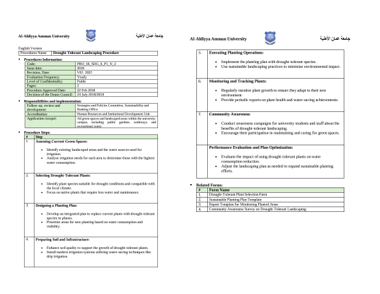
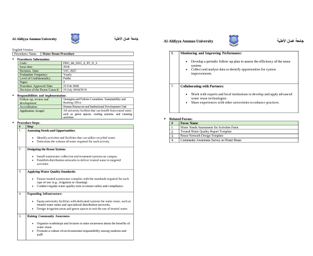
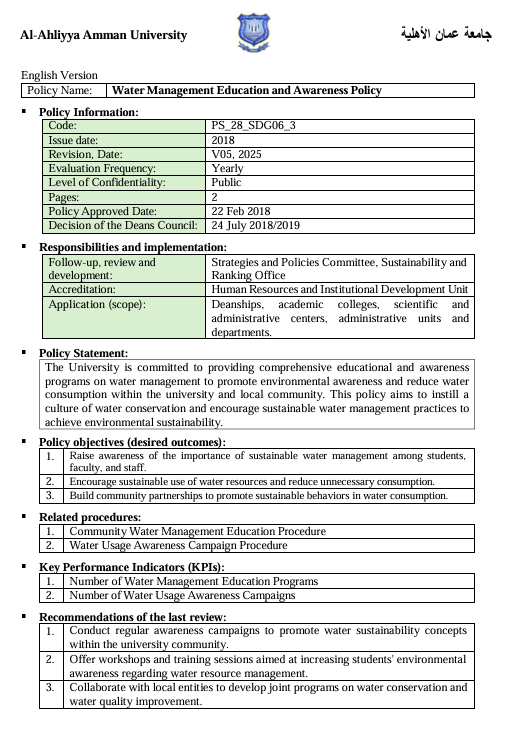
This initiative is guided by official sustainability documents including:These frameworks ensure that every green zone on campus follows low-impact, water-efficient, and climate-adapted design standards, directly supporting SDG 6.4 (Water-Use Efficiency) and SDG 15.3 (Land Degradation Neutrality), while contributing to SDG 13 (Climate Action) through resilience-oriented landscaping.
Centers and Departments
02General Supplies and Services Department – Field Operations and Maintenance
03Hourani Center for Applied Scientific Research – Research and Innovation
04Finance Department – Budget Allocation for Sustainable Infrastructure
05Center for Innovation and Entrepreneurship – Student Engagement Projects
Activities
01Implementation of the Drought-Tolerant Landscaping Procedure (Ongoing)
02Expansion of Treated Water Reuse for Irrigation (2024–2025)
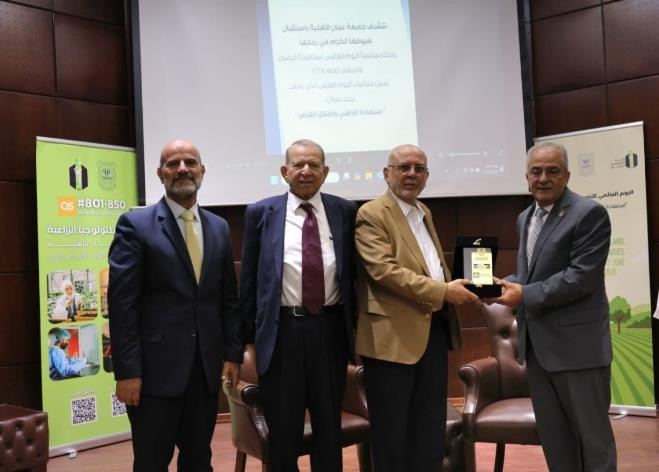
03AAU Organizes Scientific Day to Mark the World Day to Combat Desertification and Drought
04Green Corridor and Eco-Garden Development (2024–2025)
05“Green Campus, Blue Planet” Awareness Campaign (2025)
Impact Evaluation & Development Plan
- Performance Evaluation Coverage: 100% of campus green areas follow drought-tolerant landscaping standards. Water savings: ~40% reduction in irrigation water use compared to 2022 baseline. Reuse efficiency: 100% of irrigation water sourced from treated or harvested systems. Biodiversity impact: 25 native plant species maintained and expanded annually. Environmental education: >1,000 students engaged in awareness and field projects since 2023.
Development Actions
- Action 1: Expand smart irrigation automation to cover all campus zones. Action 2: Integrate real-time soil and weather sensors for adaptive irrigation scheduling. Action 3: Develop research projects on green roofs and vertical gardens using treated water. Action 4: Collaborate with local municipalities on urban greening and heat island mitigation. Action 5: Publish an annual Water-Smart Landscaping Performance Report with metrics on reuse, biodiversity, and carbon impact.
Benchmarking & Best Practice
- Adopted Practice: Aligned with FAO’s Guidelines for Efficient Water Use in Arid Landscapes and the Jordanian Ministry of Water and Irrigation’s National Water Strategy (2023–2040). Local Adaptation: AAU integrates native species selection, natural mulching, and treated-water irrigation systems adapted to Jordan’s semi-arid climate, reducing evaporation and runoff losses. Future Benchmark Goal (by 2028):
- Achieve an additional 20% reduction in irrigation water use.
- Expand biodiversity coverage to 40 native plant species.
- Develop a carbon-positive landscape zone powered by solar irrigation systems.