Contact Office On
Published Progress – SDG1
Public reporting on university progress and performance related to SDG1 (No Poverty).
Executive Summary
Al-Ahliyya Amman University (AAU) maintains a strong commitment to transparency in monitoring and communicating its progress on SDG 1 – No Poverty, in alignment with national and global reporting frameworks. Through the Sustainability & International Ranking Center (SIRC) and the Global Engagement Center, the University publicly releases annual reports detailing its efforts to reduce economic hardship, enhance social mobility, and support vulnerable groups both on campus and in the wider community.
AAU’s sustainability and executive reports are publicly accessible through its official website, providing open access to verified data on student financial support, scholarships, employment-readiness initiatives, community partnerships, and staff welfare. Between 2023 and 2025, the University documented measurable progress in poverty-reduction initiatives, including increased scholarship funding, the expansion of student-assistance programs, employability partnerships, and community outreach projects that promote economic resilience.
This commitment to evidence-based public disclosure reflects the University’s belief that higher education should serve as a catalyst for social equity and inclusive prosperity, advancing SDG 1 (No Poverty) and SDG 17 (Partnerships for the Goals).
Centers and Departments
02Finance Department
03Deanship of Student Affairs
04Global Engagement Center
05Marketing and Communications Unit
Activities
01AAU Sustainability Report 2023–2024
02Executive Sustainability Report (SDG 1 Section) 2023–2024
03AAU Participates in the Career Accelerator Program “Employment” and Signs an MoU with INJAZ
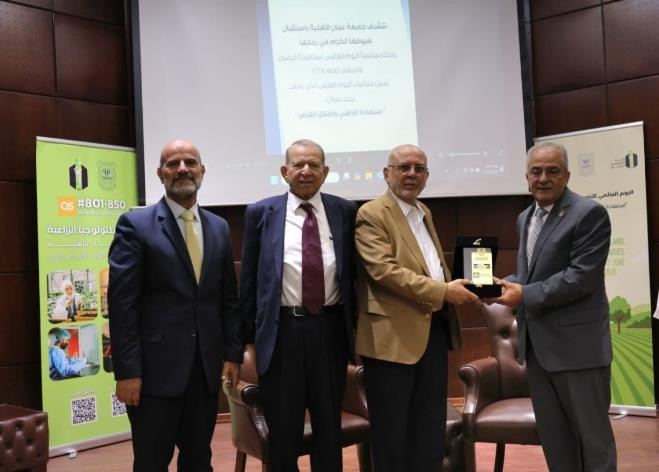
04Amman Al-Ahliyya University Organizes Scientific Day Marking the World Day to Combat Desertification and Drought
05Al-Ahliyya Amman University Signs Cooperation Agreement with Bab Al Qamar Jeeny to Enhance Practical Training and Digital Skills
06Dr. Al-Hourani Honors AAU’s Choir and Grants a 50 % Tuition Discount
Impact Evaluation & Development Plan
Performance Evaluation
- Comprehensive Public ReportingAAU publishes detailed Sustainability Reports and Executive Sustainability Reports that include dedicated sections on SDG 1. These reports present:
- the scope and value of scholarships and financial-aid schemes
- student-support mechanisms and flexible tuition arrangements
- community-based initiatives that enhance employability and income opportunities
- Key documents include:
- AAU Sustainability Report 2023–2024
- Executive Sustainability Report – SDG 1 Section 2023–2024
- Student and Community ImpactAAU’s published reports indicate that more than 40 % of AAU students benefit from partial or full scholarships, tuition-aid, or flexible payment schemes, demonstrating a direct institutional contribution to reducing economic barriers to higher education. Additional measures include:
- targeted discounts and merit-based tuition reductions, such as the 50 % tuition discount granted by Dr. Al-Hourani to AAU’s Choir, which both recognizes excellence and alleviates financial pressure on talented students;
- partnerships that strengthen students’ readiness for decent work and income generation, such as AAU’s participation in the Career Accelerator “Employment” Program and the MoU with INJAZ, which support youth employability and financial independence.
- Collaborative and Cross-Sector ApproachAAU’s reporting on SDG 1 is based on data collected from multiple units, including the Financial Aid Department, the Deanship of Student Affairs, the Sustainability & International Ranking Center, and career-development offices. This integrated approach ensures:
- accurate and verified data on scholarships, support services, and employment-related initiatives;
- coherence with national SDG 1 indicators and social-equity priorities.
- Verification and Accountability Each report undergoes internal review and indicator validation under the supervision of the Sustainability & International Ranking Center before publication on the AAU website. This process ensures that:
- SDG 1-related indicators are consistent, traceable, and evidence-based;
- external stakeholders can rely on AAU’s data for benchmarking and policy dialogue.
Development Actions
- Action 1: Open-Access SDG 1 Dashboard (2025–2028) Develop an online, interactive dashboard providing real-time or regularly updated public data on AAU’s anti-poverty measures (scholarship coverage, student-support schemes, poverty-related outreach).
- Target: Dashboard launched in 2026; updated at least twice per year with key SDG 1 metrics.
- Target: Comprehensive “SDG 1 – No Poverty Impact Report” released every May starting in 2025.
- Target: At least 5 new employability-focused MoUs signed by 2028; annual tracking of graduate employment outcomes integrated into SDG 1 reporting.
- Target: Adoption of FAIR-inspired data principles and external or cross-unit validation of SDG 1 datasets by 2027.
- Target: At least 2 international policy briefs and 1 regional SDG 1-focused forum produced or co-hosted by AAU by 2028.
Benchmarking & Best Practice
- Benchmarking Reference: AAU’s SDG 1 reporting is benchmarked against global best-practice models adopted by:
- University of Melbourne (Australia)
- University of Cape Town (South Africa)
- King’s College London (UK)
- annual publication of open-access sustainability and executive reports;
- use of quantitative indicators such as scholarship coverage, student-support ratios, and number of community beneficiaries;
- integrating social-equity and financial-access metrics into institutional performance reviews and strategic planning.
- prioritizing access to higher education for low-income and vulnerable students;
- supporting students from marginalized communities through targeted aid and flexible payment schemes;
- linking skills-development programs to national employment and digital-transformation priorities.