Contact Office On
Academic Freedom Policy
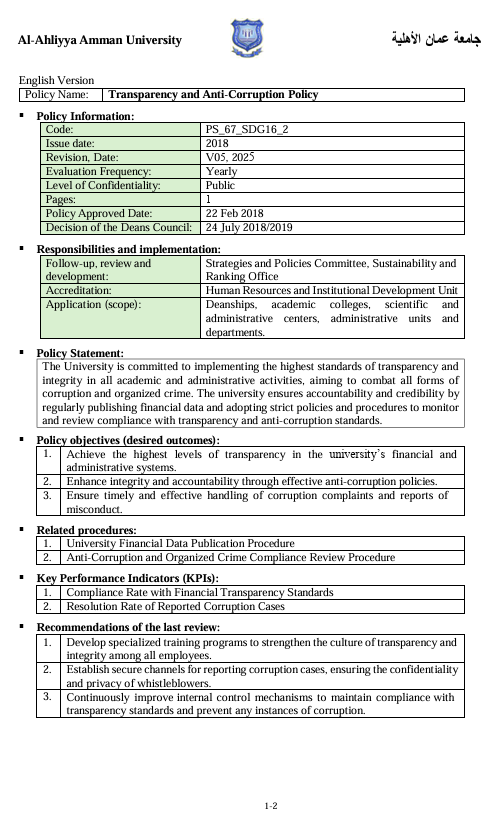
Policy supporting academic freedom in teaching, research, and public communication.
Executive Summary
Al-Ahliyya Amman University (AAU) upholds academic freedom as a core institutional principle that supports independent teaching, free intellectual inquiry, evidence-based research, and open public communication. The university recognizes academic freedom as essential to the advancement of knowledge, critical thinking, and community development, and aligns its practices with SDG16.10, which emphasizes the protection of fundamental freedoms.
AAU’s commitment to academic freedom is formally established through the Academic Freedom Support Policy and the Academic Freedom Compliance Review Procedure, both of which guarantee that faculty members, researchers, and students can engage in academic activities without interference, censorship, or undue influence. This framework ensures protection of research independence, freedom of expression in academic settings, and impartiality in knowledge dissemination.
Centers and Departments
02Hourani Center for Applied Scientific Research (HCASR)
03Teaching and Learning Center (TLC)
04Global Engagement Center (GEC)
05Center for Innovation and Entrepreneurship (CIE)
Activities
01Publication of the Academic Freedom Support Policy
02Implementation of the Academic Freedom Compliance Review Procedure
03Digital Transformation Conference Under the Patronage of Princess Alia
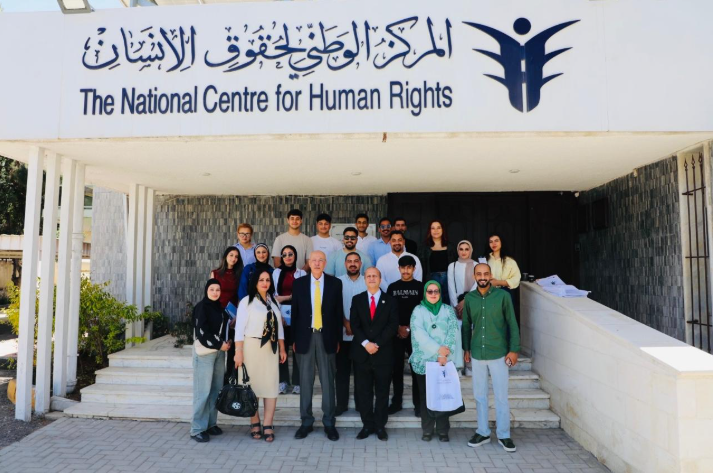
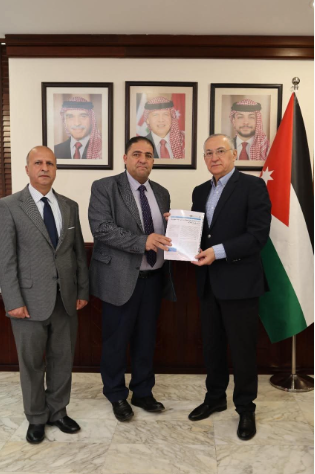
04Visit to the National Center for Human Rights
05Minister of State for Legal Affairs Campus Dialogue
06AAU Study on Criminalizing Corruption Submitted to National Authorities
Impact Evaluation & Development Plan
- Performance Evaluation AAU has a formally published Academic Freedom policy available to the public. The Academic Freedom Compliance Review Procedure ensures structured protection mechanisms. Research independence is fully supported through institutional and operational practices. Faculty members freely design curricula and pursue research agendas. Public academic events demonstrate unrestricted intellectual discourse. Official news provides clear evidence of open, critical, and systematic engagement.
Development Actions
- Action 1: Launch annual “Academic Freedom Report” documenting institutional cases, protections, and academic activities. Action 2: Develop academic freedom training programs for faculty and early-career researchers. Action 3: Expand international research collaborations to strengthen free academic exchange. Action 4: Digitalize the academic freedom complaint and compliance review system. Action 5: Host annual academic freedom forums in partnership with legal and human-rights institutions.
Benchmarking & Best Practice
- Adopted Global Best Practices:
- Alignment with UNESCO’s Recommendation on the Status of Higher-Education Teaching Personnel (1997).
- Compliance with international standards protecting academic freedom and free access to scientific information.
- Supports national efforts to strengthen academic quality, research integrity, and freedom of intellectual inquiry.

- Reinforces collaboration with national legal, human-rights, and regulatory bodies.
Institutional Integration Summary
Academic freedom is embedded in AAU’s governance system through official policies, compliance procedures, independent research centers, and continuous academic–public dialogue. The university ensures that teaching, research, and public academic communication remain unrestricted, ethical, and aligned with global standards fully supporting SDG16’s goals of justice, openness, and protection of fundamental freedoms.