Contact Office On
Pollution Prevention
Systems and protocols to prevent polluted water entering the environment or water system.
Introduction
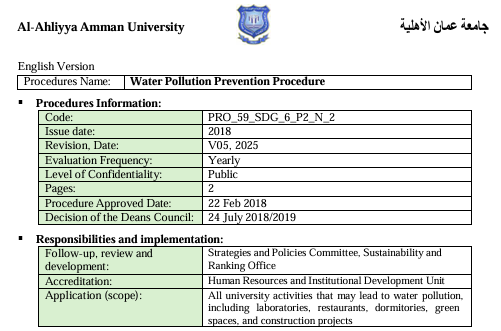
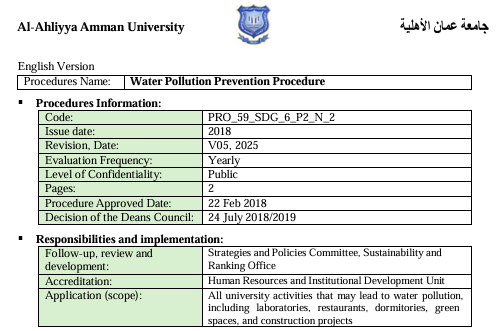
Al-Ahliyya Amman University (AAU) has developed a comprehensive institutional framework to prevent any form of water pollution on campus or in its surrounding environment. This system integrates policies, procedures, and operational controls that ensure all wastewater, laboratory effluent, and stormwater runoff are safely managed in compliance with national and international standards.
The framework is anchored by the following key institutional documents:Together, these policies establish a prevention-first approach, prioritizing risk elimination, chemical safety, wastewater containment, and continuous awareness. This comprehensive model aligns directly with SDG 6.3 (Improve Water Quality by Reducing Pollution) and indirectly supports SDG 3 (Good Health and Well-being), SDG 12 (Responsible Consumption and Production), and SDG 13 (Climate Action).
Centers and Departments
02General Supplies and Services Department – Drainage and Treatment Operations
03Pharmacological and Diagnostic Research Center – Laboratory Verification and Analysis
04Hourani Center for Applied Scientific Research – Applied Solutions for Pollution Control
05Medical Services Department – Environmental Health and Occupational Safety
Activities
01Pollution Prevention and Water Safety Policy Implementation (2025)
02Hazardous Chemical Handling and Disposal Framework (Ongoing)
03Eco Filtration and Low-Impact Landscaping Initiative (2024–2025)
04Smart Water Monitoring and Consumption Control (2025)
05Environmental Awareness and Community Engagement Campaign – “Keep Water Clean, Keep Life Green” (2025)
Impact Evaluation & Development Plan
Performance Evaluation
- Zero untreated discharge incidents since 2022.
- 100% compliance with wastewater and chemical safety standards.
- Full implementation of all relevant water policies and procedures.
- Regular monitoring by PDRC confirming pollutant levels below legal limits.
- Visible environmental improvement through cleaner reuse water and reduced surface runoff.
Development Actions
- Action 1: Introduce AI-based leakage and contamination detection within the smart water dashboard. Action 2: Establish a Central Hazardous Waste Storage Unit with advanced containment systems. Action 3: Expand joint research projects on eco-filtration and bio-remediation with the Hourani Center. Action 4: Strengthen the Clean Water Culture 2030 awareness framework across all faculties. Action 5: Conduct an ISO 14046 Water Footprint Assessment and integrate results into annual sustainability reporting.
Benchmarking & Best Practice
- Adopted Practice: Complies with Jordanian Environmental Law No. 85/2015, ISO 14001, and WHO Water Quality Guidelines to ensure safe wastewater and chemical waste handling. Local Adaptation: Applies arid-climate approaches through Drought-Tolerant Landscaping Procedure and decentralized filtration solutions tailored to AAU’s campus ecosystem. Future Benchmark Goal (by 2028):
- Maintain zero-pollution discharge record.
- Achieve 100% real-time digital monitoring.
- Publish two peer-reviewed research studies annually on pollution prevention and water quality management.