1717.3.6

Published Progress – SDG6

Public reporting on university progress and performance related to SDG6 (Clean Water and Sanitation).

Introduction

Al-Ahliyya Amman University (AAU) demonstrates full transparency and accountability in its efforts to ensure sustainable water use, sanitation, and hygiene management, in alignment with SDG 6 – Clean Water and Sanitation. The University systematically documents and publishes its performance on water conservation, wastewater treatment, awareness initiatives, and water reuse systems through the Sustainability and International Ranking Center (SIRC) and the Facilities and Environmental Services Department.

Between 2023 and 2025, AAU implemented several evidence-based initiatives to achieve measurable progress in water efficiency and management, including:

  • the installation of water-recycling and treatment units across campus,
  • the adoption of rainwater-harvesting and smart monitoring systems,
  • the enforcement of Water Usage Awareness and Pollution Prevention Policies, and
  • the continuous public disclosure of water consumption and reuse data.

All related indicators and outcomes are publicly available through AAU’s Sustainability Reports, Executive Summaries, and online sustainability platform, ensuring transparency and compliance with UN SDG 6 targets (6.1 – 6.6) and SDG 17 (Partnerships for the Goals).

Centers and Departments

01Sustainability and International Ranking Center

Coordinates water data collection, reporting, and verification. Publishes annual performance metrics and sustainability reports.

02General Supplies and Services Department

Manages water infrastructure, monitoring, and treatment. Provides operational data for transparent reporting on water use and reuse.

03Deanship of Student Affairs

Oversees water-awareness campaigns and community outreach. Publishes educational and behavioral-impact reports.

04Finance Department

Supports budget transparency for water infrastructure projects. Ensures financial accountability and sustainability investments.

05Marketing and Communications Unit

Disseminates official sustainability publications. Promotes visibility of AAU’s clean-water initiatives.

Activities

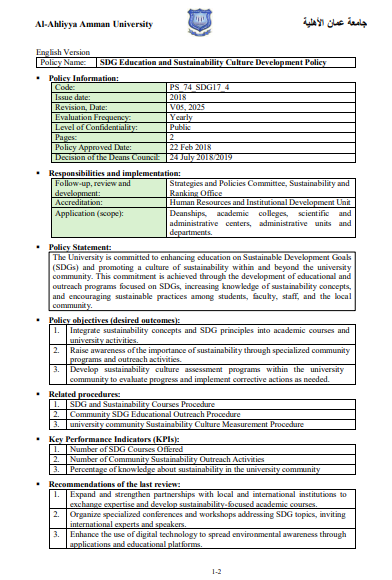
01AAU Sustainability Report 2024 – 2025

AAU’s Sustainability Report 2024–2025 includes comprehensive and verifiable data on water consumption, wastewater treatment, and recycling outcomes. The report showcases AAU’s measurable performance improvements in water efficiency and pollution prevention, reinforcing its transparency under SDG 6 (Clean Water) and SDG 17 (Partnerships).

02Executive Sustainability Report (SDG 6 Section) 2024 – 2025

The Executive Sustainability Report provides a summarized overview of AAU’s clean-water management systems, conservation measures, and wastewater reuse programs. It ensures transparent communication of water-related achievements to stakeholders, aligning with SDG 6.3 (Water Quality) and SDG 6.4 (Water Efficiency).

03AAU Water Treatment and Reuse Policy

AAU publicly released its Water Treatment and Reuse Policy, detailing standards, procedures, and monitoring systems for treated-water use across the campus. The policy’s publication ensures accountability and demonstrates AAU’s compliance with SDG 6 (Clean Water), SDG 12 (Responsible Consumption), and SDG 17 (Transparency in Governance).

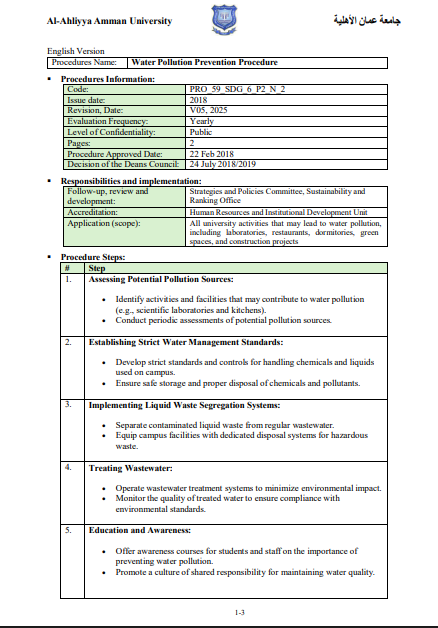
04AAU Wastewater Treatment and Pollution Prevention Procedures

The University has developed and published its Wastewater Treatment Procedure and Water Pollution Prevention Procedure, ensuring high standards of wastewater quality and environmental protection. Public availability of these procedures enhances institutional transparency and promotes stakeholder engagement in sustainability governance, supporting SDG 6.3 and SDG 12.4.

05University Hosts Beach Cleanup at Aqaba Sea to Support Marine Conservation Efforts

Al-Ahliyya Amman University organized a large-scale beach cleanup campaign at the Aqaba Sea as part of its commitment to clean water and ecosystem protection. The initiative brought together students, staff, and NGO partners to remove marine waste and raise awareness about water pollution prevention. Publicly reported on the university’s official news portal, this activity exemplifies AAU’s transparent commitment to SDG 6.3 (Water Quality) and SDG 17 (Partnerships for the Goals) through community engagement and environmental stewardship.

Impact Evaluation & Development Plan

Performance Evaluation

  1. Comprehensive Public Reporting: AAU regularly publishes accurate data on total water use, recycled volumes, and wastewater treatment performance through its annual sustainability reports. Policy Implementation: The University has adopted several institutional frameworks including the:
    • Water Treatment and Reuse Policy,
    • Wastewater Treatment Procedure,
    • Water Pollution Prevention Procedure, and
    • Water Reuse Procedure. All of these are publicly accessible on AAU’s Sustainability Portal.
    Water Efficiency Achievements: Between 2023 and 2025, AAU recorded measurable reductions in total freshwater use and significant increases in recycled-water utilization, demonstrating a proactive approach to resource efficiency. Awareness and Engagement: The Deanship of Student Affairs and Sustainability Clubs conduct annual water conservation campaigns to educate students and staff on responsible water use. Verification and Accountability: All data are cross-checked by the Sustainability Center and verified through collaboration with the Facilities Department before publication, ensuring transparency and accuracy.

    Development Actions

  2. Action 1: Water and Sanitation Dashboard (2025 – 2028), Create a real-time digital dashboard to publicly display water usage and recycling metrics, Launch by 2026; updated every 6 months. Action 2: Wastewater Reuse Expansion Project (2025 – 2028), Increase the proportion of treated wastewater used for irrigation, 30 % increase in reuse by 2027. Action 3: Rainwater Harvesting Enhancement (2025 – 2028), Expand collection systems and integrate smart sensors, 25 % higher annual capture rate by 2028. Action 4: Community Water Awareness Program (2025 – 2028), Partner with NGOs and schools to raise public awareness on water security, 10 community campaigns per year; 2,500 participants. Action 5: Water Research and Innovation Grants (2025 – 2028), Support applied research on water management and pollution reduction, 5 funded projects annually with published outcomes.

    Benchmarking & Best Practice

  3. AAU’s public reporting on SDG 6 follows international best practices modeled by institutions such as the University of Leeds (UK), University of Melbourne (Australia), and American University of Sharjah (UAE); all of which integrate real-time data transparency into their sustainability frameworks. Adopted Practices:
    • Annual open-access publication of water-related metrics.
    • Integration of water-use efficiency indicators into institutional performance audits.
    • Publicly accessible policies on water treatment and pollution prevention.
    Localization: AAU aligns its approach with Jordan’s National Water Strategy (2023–2040) and the Ministry of Water and Irrigation’s Sustainable Resource Management Framework, ensuring local relevance and national contribution. Future Goal (by 2028): Launch the AAU Smart Water Management Observatory, linking IoT-based water monitoring systems with the University’s public reporting dashboard for real-time transparency. Institutional Integration Summary At Al-Ahliyya Amman University (AAU), the implementation, monitoring, and public reporting of SDG 6; Clean Water and Sanitation are governed through a fully integrated and transparent framework. The Sustainability and International Ranking Center (SIRC) leads the coordination process, systematically collecting quantitative and qualitative data from the Facilities and Environmental Services Department, the Finance Department, and the Deanship of Student Affairs, while collaborating with the Information Technology Center to ensure that all water-related information is digitally accessible. Each department is responsible for recording specific indicators; such as total water consumption, treated and reused volumes, sanitation compliance rates, and awareness-program outcomes. These datasets are verified by SIRC for accuracy and consistency before being reviewed by the University Presidency and approved for publication through the AAU Sustainability Portal, Annual Sustainability Reports, and Executive Summaries. This workflow ensures that all SDG 6 achievements are evidence-based, externally verifiable, and publicly available, reflecting AAU’s institutional culture of accountability and environmental responsibility. Furthermore, the reporting process is aligned with Jordan’s National Water Strategy (2023–2040) and the UN SDG 6 targets (6.1 – 6.6), guaranteeing both local relevance and global comparability. Through this structured model, AAU positions water and sanitation sustainability as a university-wide responsibility, where every department contributes measurable impact toward achieving clean-water efficiency, pollution prevention, and transparent governance, directly advancing SDG 6 (Clean Water and Sanitation) and SDG 17 (Partnerships for the Goals).

Contact Office On

  • Email: sdo@ammanu.edu.jo
  • Phone: +962 5 3500211
  • Extension: 2060
  • Address: Al-Ahliyya Amman University / Amman-Jordan- Al Salt Road / Zip-Code (Postal Address): (19328)
  • Fax: +962 6 5336104

Al-Ahliyya Amman University

Email: Public@ammanu.edu.jo


© Copyright Al-Ahliyya Amman University. Amman, Jordan 19111.