Al-Ahliyya Amman
University has developed a comprehensive strategy to
advance interdisciplinary research, supported by a tiered governance model that together form the institutional
foundation for academic excellence, ethical integrity, and measurable research impact. Both the strategy and the
framework are aligned with Jordan's national development priorities, the UN Sustainable Development Goals, and the
governance standards adopted by leading research universities worldwide.
Interdisciplinary research is
a cornerstone of excellence and innovation. AAU has adopted a comprehensive strategy to advance it, guided by a
clear mission and measurable objectives that reflect the university's long-term commitment to knowledge
integration, societal impact, and global research competitiveness.
AAU advances interdisciplinary research by
cultivating an environment where Engineering, Life Sciences, Physical Sciences, Computer Science,
Business, Law, Arts, and Social Sciences converge rather than coexist in isolation. The
university's mission is to facilitate genuine collaboration across disciplines, support excellence in
publishing, forge strategic partnerships with regional and international institutions, and generate knowledge
that produces innovative solutions with lasting scientific and developmental impact.
Strategic Implementation
Orientation
This strategy functions as an
operational guide, not only a conceptual statement. It directs institutional action across research capacity,
cross-college collaboration, funding, partnerships, and international visibility. Its objectives are anchored in
AAU's 2025–2030 Strategic Plan and oriented toward Jordan's national development priorities and the United Nations
Sustainable Development Goals. Progress against each strategic objective is measured through a comprehensive,
evidence-based KPI framework built on Scopus and SciVal bibliometric data covering 4,064 peer-reviewed
publications from 2021 to 2025. This framework, detailed in the Roadmap and KPIs section of this portal, tracks
performance across five dimensions: citation impact, visibility and reach, topic prominence, collaboration, and
societal impact. Real-time institutional performance is further monitored through AAU’s Interdisciplinary Research
Performance Dashboard, a live bibliometric intelligence platform that tracks cross-disciplinary indicators, FWCI,
Topic Prominence, and ISR alignment across partner universities. Findings are reported on a semester basis to the
Interdisciplinary Research Committee and annually to AAU’s University Council.
1
Establish Interdisciplinary Research Centers
Create dedicated institutional spaces where
researchers from different colleges address shared challenges together, moving beyond departmental
boundaries toward integrated knowledge production.
2
Allocate Sustainable Funding for Joint Interdisciplinary Research
Establish a dedicated internal grants
scheme ensuring ongoing financial support for cross-disciplinary research initiatives, reducing
researchers' dependence on external funding cycles.
3
Develop Interdisciplinary Academic Courses
Integrate interdisciplinary methods and
perspectives into postgraduate and undergraduate curricula, equipping the next generation of AAU graduates
with the capacity to think and work across fields.
4
Form
Interdisciplinary Research Teams
Establish formally constituted
cross-disciplinary research teams that operate according to shared research plans, bridging faculties and
research centres around defined priority themes.
5
Support High-Quality Publication in International Interdisciplinary Journals
Direct researchers toward reputable
internationally indexed journals covering multiple disciplines, strengthening the visibility, citation
impact, and global reach of AAU's research output.
6
Enhance International and Local Research Collaboration
Broaden AAU's interdisciplinary research
through active partnerships with Jordanian institutions and global academic networks, increasing
co-authorship diversity and joint project activity.
7
Establish Partnerships with the Industrial Sector
Apply interdisciplinary research outcomes
in practical settings by building structured relationships with industry and government, addressing
real-world challenges and national economic priorities.
8
Offer
Workshops and Specialized Seminars
Build faculty and graduate student
competencies through regular capacity-building events focused on interdisciplinary research design,
collaboration methods, and bibliometric awareness.
9
Implement Independent External Evaluations
Subject AAU's interdisciplinary research
portfolio to periodic external review by international academics and industry experts, ensuring quality,
credibility, and continuous improvement.
📌 Implementation, Monitoring, and Review
Implementation is coordinated by the Deanship of
Scientific Research in partnership with academic faculties, research centers, and relevant administrative units.
Progress is reviewed periodically using institutional data and recognized bibliometric sources. Findings inform
corrective action, resource reallocation, and strategic reporting to AAU's University Council.
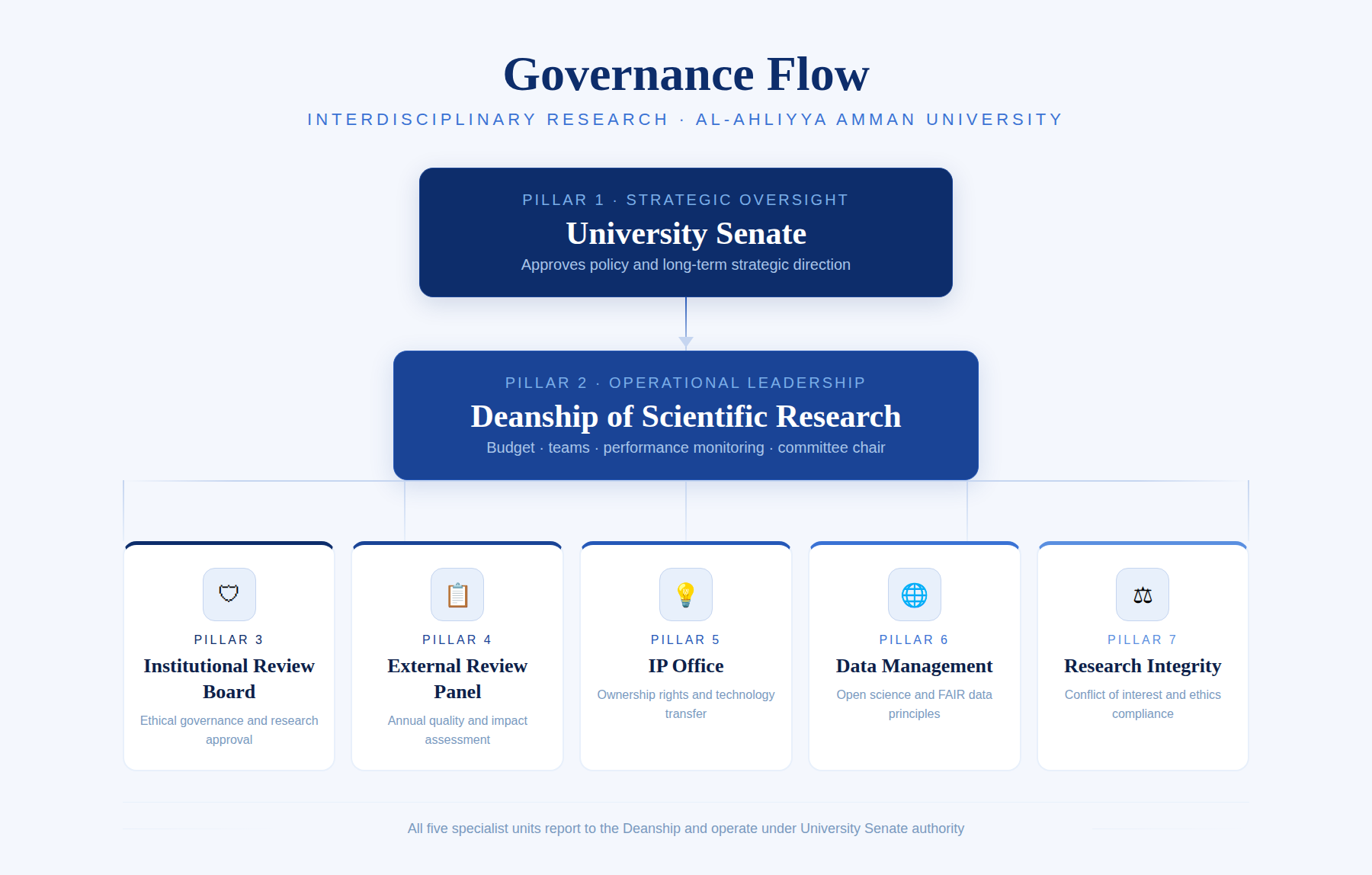
AAU's governance framework for
interdisciplinary research is designed in alignment with the standards and structures adopted by leading research
universities worldwide. It establishes a tiered institutional model that ensures accountability, transparency,
ethical integrity, and strategic coherence across all interdisciplinary research activities.
AAU advances interdisciplinary research by
cultivating an environment where Engineering, Life Sciences, Physical Sciences, Computer Science,
Business, Law, Arts, and Social Sciences converge rather than coexist in isolation. The
university's mission is to facilitate genuine collaboration across disciplines, support excellence in
publishing, forge strategic partnerships with regional and international institutions, and generate knowledge
that produces innovative solutions with lasting scientific and developmental impact.
1
Strategic Oversight
University Senate & Research Council
The University Senate approves AAU's
overarching interdisciplinary research policy and long-term strategic direction. The Scientific Research
Council serves as the primary advisory body, reviewing institutional priorities and ensuring alignment with
national and global research agendas.
2
Operational Leadership
Deanship of Scientific Research
The Deanship provides day-to-day operational
governance, overseeing budget allocation, researcher capacity building, interdisciplinary team formation,
and performance monitoring. The Dean of Scientific Research chairs the Interdisciplinary Research Committee
and reports directly to the University President.
3
Ethical Governance
Institutional Review Board (IRB)
All interdisciplinary research involving human
participants, sensitive data, or vulnerable populations is subject to IRB review. The IRB applies
internationally recognised ethical standards including the Helsinki Declaration and CIOMS Guidelines, and
issues formal approval before research commences.
4
Quality Assurance
External Review Panel
An annual external review panel comprising
international academics and industry experts evaluates the quality and impact of AAU's interdisciplinary
research portfolio. The panel submits a formal report with recommendations reviewed and adopted by the
Research Council.
5
Intellectual Property and Technology Transfer
IP Policy
AAU's Intellectual Property Policy defines
clear ownership rights, revenue-sharing arrangements between the university and researchers, and
commercialization pathways for research outputs including patents, software, and consultancy services. All
interdisciplinary research teams receive IP orientation at project inception.
6
Research Data Management and Open Science
Open Science Policy
AAU adopts a Research Data Management policy
aligned with open science principles, requiring all publicly funded interdisciplinary research to follow
FAIR data standards: Findable, Accessible, Interoperable, and Reusable. Research data is
archived in institutional and international repositories.
7
Research Integrity
Conflict of Interest & Integrity
Framework
All researchers declare conflicts of interest
at project initiation and publication stages. AAU adopts the Singapore Statement on Research Integrity as
its guiding framework and maintains a Research Integrity Officer role within the Deanship to investigate
misconduct allegations and protect whistleblowers.
📌
These seven pillars provide AAU with a governance
structure that is principled in its ethics, clear in its accountability, and designed to
support interdisciplinary research that is rigorous, impactful, and sustainable over the long term.
Key Performance Indicators
AAU's KPI framework for
interdisciplinary research is grounded in the findings of the bibliometric study 'Where Disciplines Meet,
Excellence Follows' (2025), which analysed 4,064 peer-reviewed articles and reviews published between 2021 and
2025 using Scopus and SciVal data. The baselines below reflect actual measured performance. The 2028 targets
represent ambitious but evidence-based institutional commitments aligned with AAU's 2025–2030 Strategic Plan.
These indicators track progress across five
dimensions: research output and quality, visibility and reach, topic prominence, collaboration, and
societal impact. Progress is reviewed periodically by the Deanship of Scientific Research using
Scopus and SciVal data, with findings reported to AAU's University Council and the Interdisciplinary Research
Committee.
Baseline 2021–2025
2028 Target
Mean Citations per Paper
Raw citation count averaged across all papers
17.98
(Inter) vs 12.22 (Regular) - Inter +47%
Mean FWCI
Field and year normalised citation impact.
World average = 1.0
3.065
(Inter) vs 2.190 (Regular) - Inter +40%
Research Strength (75th pct FWCI)
THE ranking methodology indicator
2.950
(Inter) vs 2.440 (Regular) - Inter +21%
FW Top 10% Papers
Share in global field-weighted top 10% by
citations
29.2%
(547 papers) - Inter leads
Zero Citation Rate
Share of papers with no citations. Lower is
better.
15.1%
(Inter) vs 18.1% (Regular)
Mean Views per Paper
Scopus-tracked page views, proxy for
readership
62.7
(Inter) vs 39.3 (Regular) - Inter +60%
Mean FWVI
Field-weighted view impact. World average =
1.0
3.281
(Inter) vs 2.469 (Regular) - Inter +33%
TPP Mean
Topic Prominence Percentile - momentum of
research topic (0–100) - Inter leads
90.758
(Inter) vs 90.045 (Regular)
TCP Mean
Topic Cluster Prominence — broader research
cluster momentum
80.235
(Inter) vs 75.663 (Regular) - Inter +6%
Average CiteScore
Mean CiteScore of publishing journals
5.296
(Inter) vs 5.118 (Regular) - Comparable
CiteScore Q1 Rate
Share published in top-quartile journals -
Comparable
52.1%
(976 papers)
International Collaboration Rate
Share of papers involving 2 or more countries
64.0%
(Inter) vs 73.9% (Regular)
Mean Number of Institutions
Average partner institutions per paper
4.523
(Inter) vs 6.348 (Regular)
Mean Number of Authors
Average authors per paper
5.78
(Inter) vs 7.93 (Regular)
Cross-Faculty Publications
Papers co-authored by researchers from
different AAU colleges
Baseline
to be established
🌱
Societal Impact & Growth
Papers with at Least 1 SDG
Share linked to UN Sustainable Development
Goals
38.3%
(Inter) vs 49.8% (Regular)
Mean SDGs per Paper
Average SDG goals addressed per paper
0.53
(Inter) vs 0.61 (Regular)
Mean Count Subject
Average number of subject areas per paper —
interdisciplinarity depth
2.4
(Inter) vs 1.0 (Regular) +140%
CAGR Scholarly Output
Compound annual growth rate of publications
2021–2025
51.8%
overall — 51.3% Inter / 52.2% Regular
Open Access Rate
Share freely available via any OA route
68.8%
(Inter) vs 70.2% (Regular)
📌
KPI progress is coordinated by the
Deanship of Scientific Research in cooperation with the Centre for Sustainability and Global
Rankings. Data is drawn from Scopus and SciVal on a semester basis and reported annually to AAU's University
Council.
Strategic Roadmap 2025–2030
AAU adopts a phased five-year
implementation roadmap to institutionalise interdisciplinary research as a defining pillar of its academic
identity by 2030. The roadmap is structured around four progressive phases, each building on the achievements and
lessons of the preceding stage, anchored in the evidence base established by the 2025 bibliometric study.
Implementation is coordinated by the Deanship of
Scientific Research in partnership with academic faculties, research centres, and relevant administrative units.
Each phase carries defined milestones reviewed at the close of the phase and used to calibrate
the next.
1
Foundation
2025 - Goal: Establish the institutional infrastructure and governance framework for
interdisciplinary research.
- Formally launch the Interdisciplinary Research Committee and publish its governance charter
- Designate four interdisciplinary research teams across colleges and assign team leaders
- Audit existing research output for ISR eligibility using Scopus bibliometric data
- Establish the Interdisciplinary Research Funding Unit and publish an internal grants scheme
- Sign at least three new MoU partnerships with international universities focused on interdisciplinary
research
- Launch the first interdisciplinary research capacity-building workshop series
- Publish AAU's first Interdisciplinary Research Annual Report
2
Activation
2026–2027 - Goal: Activate research teams, grow ISR-eligible publications, and strengthen
international collaboration.
- Launch all four interdisciplinary research teams with active projects and publication plans
- Achieve Mean FWCI of 3.3 or above across the interdisciplinary portfolio
- Raise international collaboration rate from 64.0% to 68% or above
- Submit at least two grant applications to international funding bodies
- Organise first AAU Interdisciplinary Research Symposium with international participation
- Implement Research Data Management policy aligned with FAIR data principles
- Establish IP Office and brief all research teams on intellectual property rights
- Increase papers with SDG alignment from 38.3% to 45% or above
3
Growth
2028 - Goal: Consolidate citation impact, expand funding, and reach KPI targets.
- Achieve Mean FWCI of 3.5 or above and FW Top 10% rate of 35% or above
- Raise TPP Mean to 93 or above across the interdisciplinary portfolio
- File at least three interdisciplinary patents or technology transfer agreements
- Launch a joint interdisciplinary graduate programme with a partner university
- Secure JOD 150,000 or more in external competitive research grants
- Raise international collaboration rate to 72% or above
- Publish two AAU interdisciplinary research policy papers for regional impact
- Apply for THE ISR subject ranking inclusion for the first time
4
Excellence
2029–2030 - Goal: Position AAU as the leading interdisciplinary research university in
Jordan and a recognized regional contributor
- Achieve first appearance in THE ISR ranked tables
- Establish AAU as a regional hub for interdisciplinary research through an annual conference
- Launch AAU Interdisciplinary Research Centre as a standalone institutional unit
- Achieve Mean FWCI of 4.0 or above for top-performing research teams
- Commercialise at least two research innovations through industry or government partnerships
- Publish AAU's first comprehensive Interdisciplinary Research Impact Report
- Sustain CAGR of 40% or above in annual interdisciplinary publication output
📌
Monitoring and Periodic Review — The
implementation of this roadmap is reviewed at the close of each phase. Findings are used to assess progress,
identify challenges, update priorities, and ensure continued alignment between AAU's interdisciplinary research
ambitions and measurable institutional performance.