About · Al-Ahliyya Amman University

Chef Maysaa Hassiba

Lecturer, Culinary Arts and Pastry · Faculty of Hospitality and Tourism Management


A culinary educator who designed and built her own intelligent classroom — IKRAM, a smart-kitchen waste-tracking platform — to prove a single radical idea: a student's falling waste percentage is the same number as their rising skill level.

Chef Maysaa Hassiba cooking
s

Who She Is

A Chef Who Builds Her Own Tools

Chef Maysaa Hassiba is a Lecturer in Culinary Arts and Pastry at the Faculty of Hospitality and Tourism Management, Al-Ahliyya Amman University. She trained across four disciplines that almost never sit in one person — graphic design, management information systems, culinary arts, and hospitality — and that combination is the engine of everything she does in the classroom.

She teaches the way a chef must perform: from first principles, with discipline, and refusing to waste anything. She designs the way an information-systems professional thinks: turning every kitchen process into a measurable, sensor-aware, data-generating event. And she leads the way a researcher does — by building, testing, and iterating publicly, then formalising what she has learned into academic scholarship.

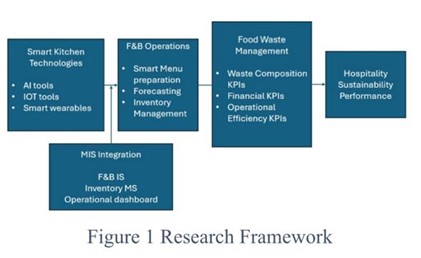
Her doctoral research, in progress, is the academic formalisation of what her classroom has already proven: that smart kitchens powered by management information systems can systematically reduce food waste while simultaneously improving the measurable skill level of the people working in them.
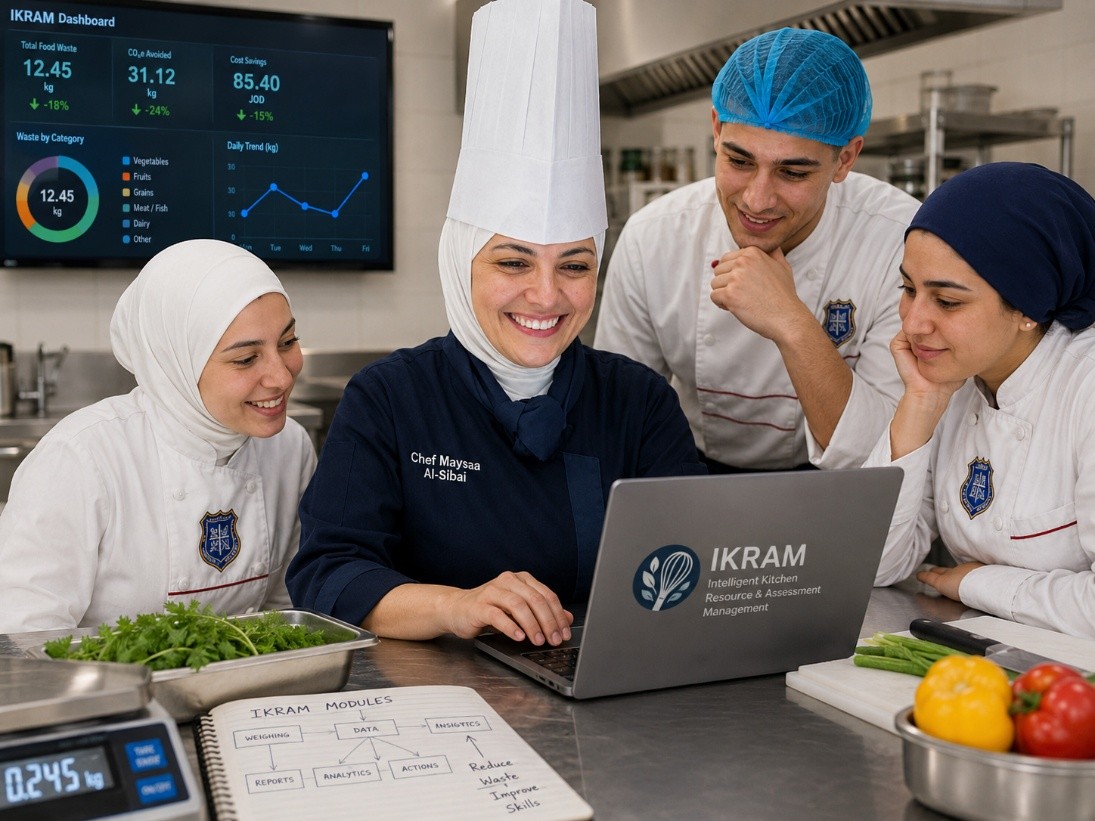
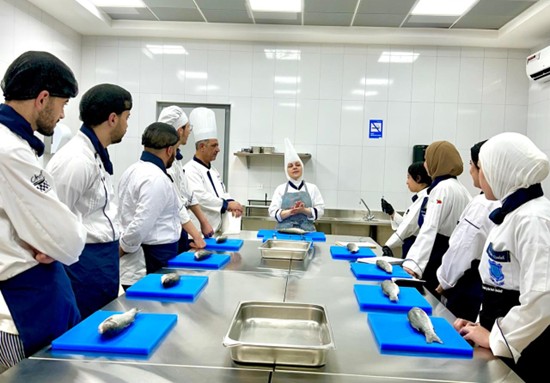
Chef Maysaa with students and IKRAM dashboard

The Three Threads

Chef · Lecturer · Innovator

01 · As a Chef

Kitchen Standards, No Exceptions

Chef Maysaa works to professional kitchen standards and demands the same of her students. She brings the discipline of HACCP food-safety thinking, FIFO inventory practice, and commercial product sensibility into every practical session. The stock powders, jams, pickles and ferments produced in her classroom are not student exercises — they are commercially viable products built to commercial standard. Her competition coaching has placed Jordanian students on the national and international platforms — for which she herself was awarded the Coach Medal by the International Jury.

02 · As a Lecturer

Evidence-Based Pedagogy

In the classroom, she rejects the dominant model of culinary teaching, which rewards technical execution while treating sustainability as decoration. Her pedagogy is built on the conviction that practical learning must be measurable, individual, and circular. Every student gets their own progression chart. Every lecture generates data. Every grade is anchored in evidence the student can read for themselves. Her official AAU student-evaluation score for Semester 1, 2025–26 — across three courses — is 98.53%.

03 · As an Innovator

Built Inside AAU, For the Arab World

When she could not find a tool that would do what her teaching philosophy required, she built one. IKRAM is a production-grade digital platform — conceived, designed and built inside Al-Ahliyya Amman University, currently in its fifth iteration and second year of live operation. It is bilingual (Arabic and English), priced in Jordanian Dinar to three-decimal accuracy, and architected from day one to be transferable to any practical-skills programme in the Arab world. The system is the curriculum, the assessment, and the evidence record — all in the same screen the student is already looking at.

Chef Maysaa teaching in the kitchen

Doctoral Research · In Progress

The Academic Formalisation of a Proven Classroom

The Impact of Smart Kitchens and MIS Integration on Food Waste Reduction and Sustainability in Food and Beverage in the Hospitality Sector

Chef Maysaa's doctoral research formalises into peer-reviewable scholarship what her classroom has demonstrated in operation: that intelligent kitchen environments, instrumented by management information systems, produce measurable, repeatable reductions in food waste — and that this reduction is inseparable from the professional development of the human beings working in those kitchens.

IKRAM is the live evidence base on which this research draws. Doctoral research and institutional teaching practice operate as one feedback loop.


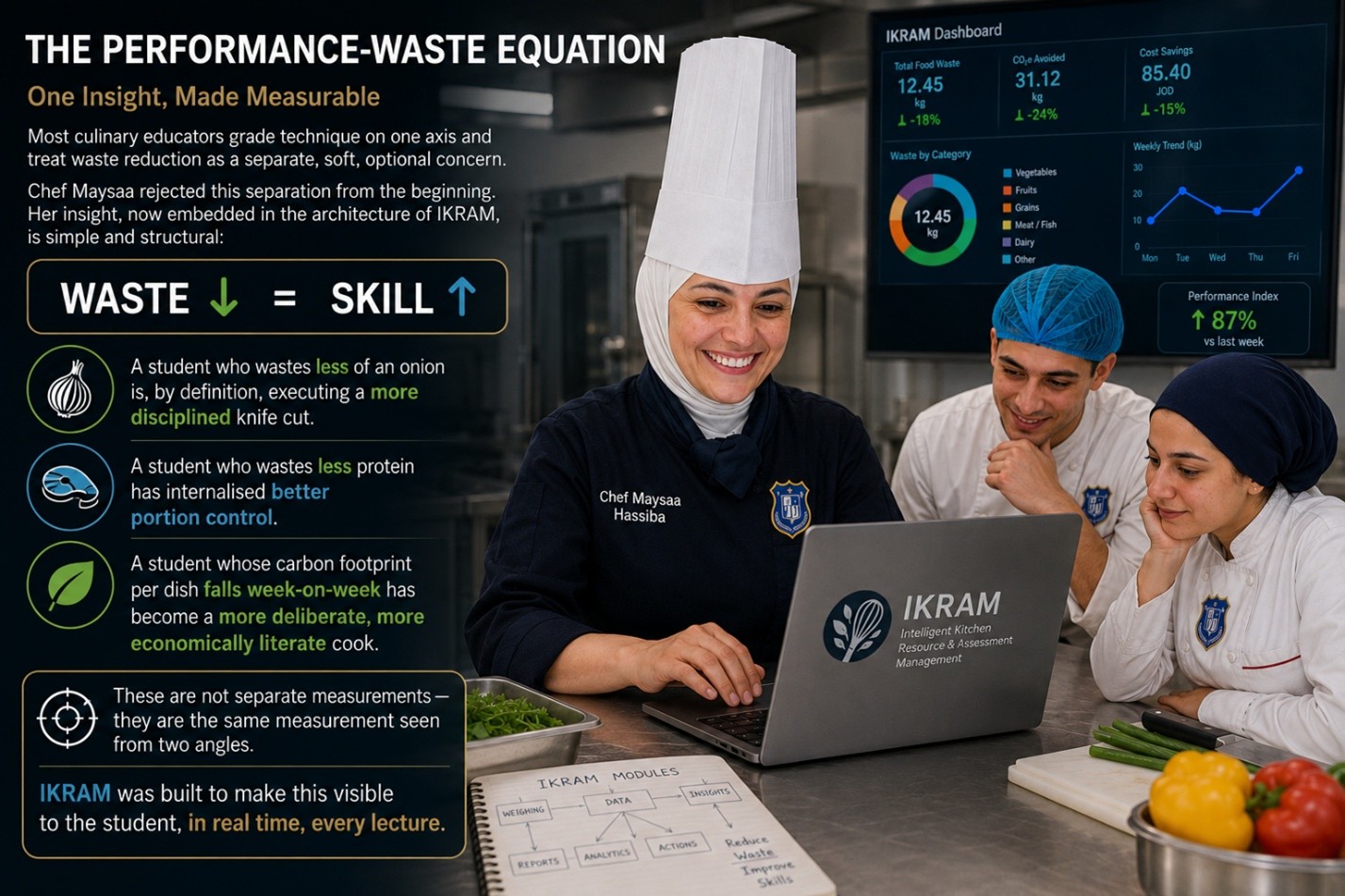
The Performance–Waste Equation

The core argument of the research — and of the teaching — is that waste percentage and skill level are not two separate metrics. They are the same number looked at from different directions. As a student's skill rises, their waste falls. IKRAM makes that relationship visible, trackable, and exportable as a professional credential.

Research framework document
The Performance-Waste Equation

Mission & Vision

What This Work Is For

Mission

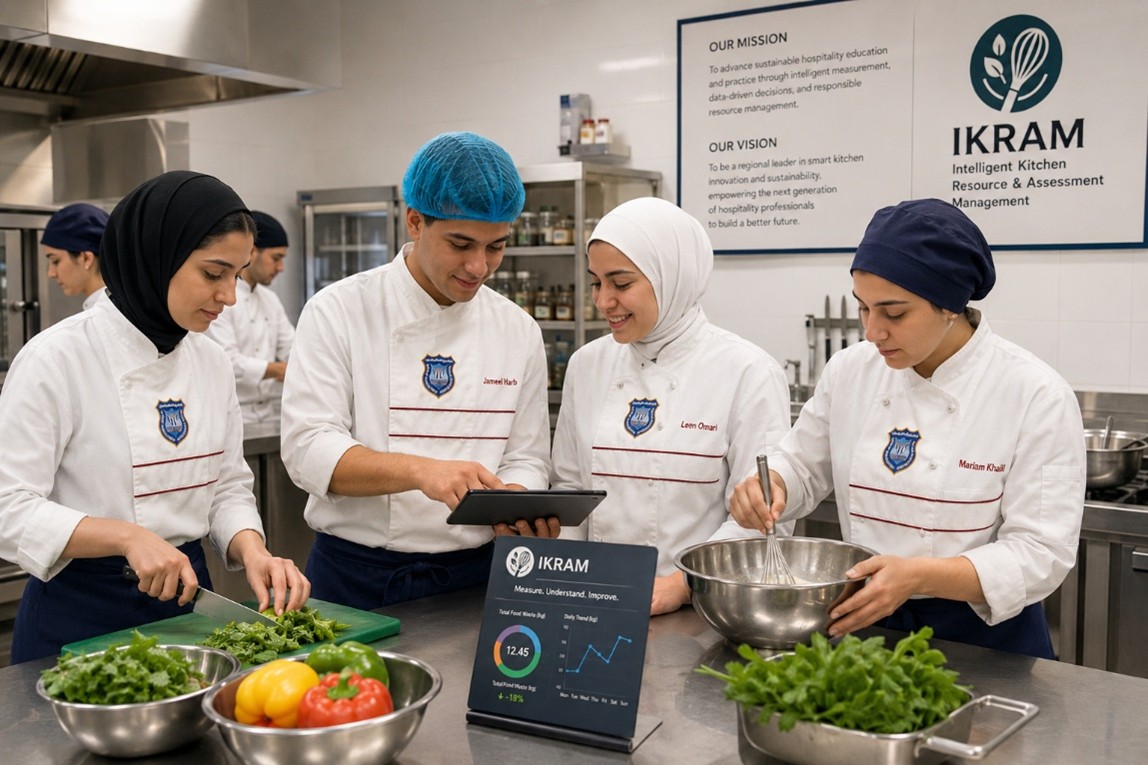
To teach every culinary student, after every practical session, with data the student can read about their own performance — and to make that data so honest, so granular, and so visible that no student in her classroom can leave without an evidence-based account of how much they have grown, how much they have wasted, and what they have learned to do about it.

Students using IKRAM in the kitchen

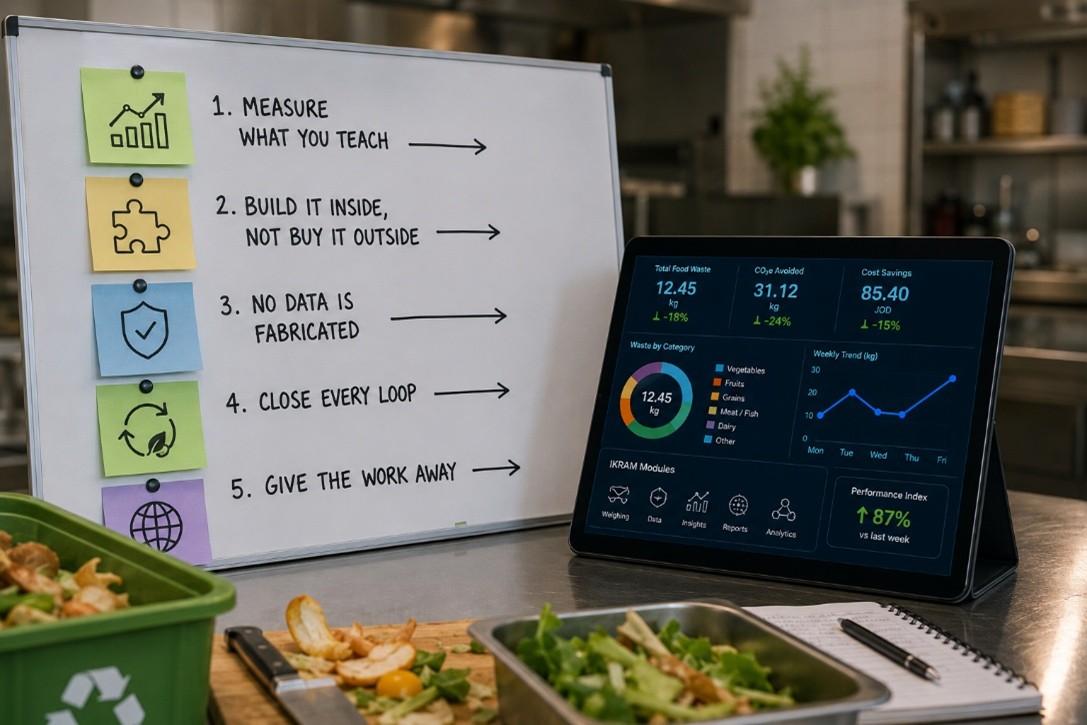
Five Innovation Principles

The Rules She Works By

1

Measure what you teach

If sustainability is not measurable, it cannot be taught. Every claim in the classroom is anchored in data the student generates and the student can read.

2

Build it inside, not buy it outside

The right tool for an Arabic-language, JOD-priced, RTL-aware culinary classroom did not exist. So she built it — inside AAU, with AAU's own people, for AAU's own students.

3

No data is fabricated

Every figure on the IKRAM dashboard comes from the official university purchase plan. The credibility of the teaching depends on the credibility of the numbers.

4

Close every loop

Waste is not responsibly managed until it has been processed, composted, or transferred under regulation. The system refuses to call sorting alone a circular outcome.

5

Give the work away

An innovation that stays inside one classroom is not an innovation. IKRAM was architected from day one to be lifted out of AAU and adopted by any peer institution that wants it.

Innovation principles whiteboard and IKRAM tablet

Future Plans & Expansion Roadmap

Where This Goes Next

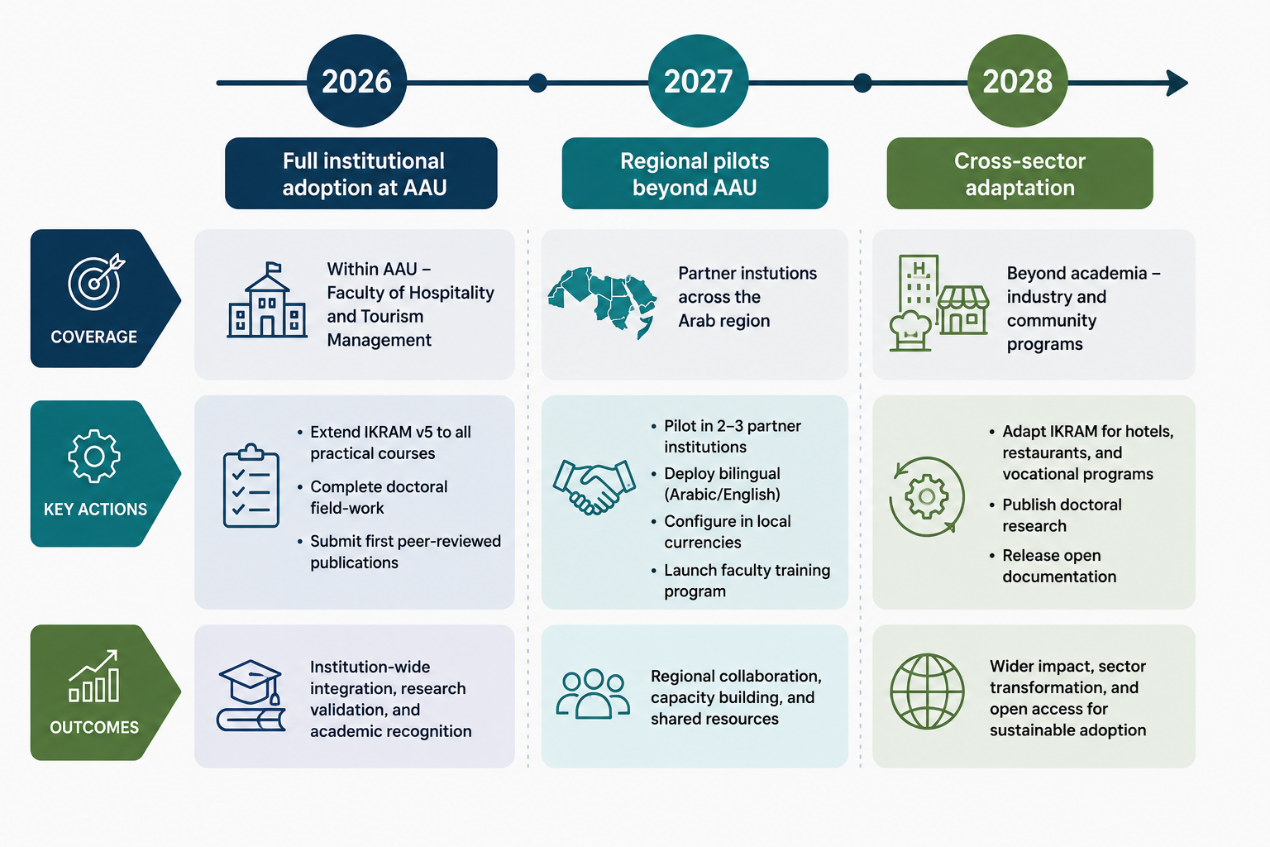
2026

Full institutional adoption at AAU

IKRAM v5 extended from the current three sections of principles of culinary arts to all practical courses across the Faculty of Hospitality and Tourism Management. Doctoral research field-work completed. First peer-reviewed publications submitted.

2027

Regional pilots beyond AAU

Two to three partner institutions in the Arab region piloting IKRAM, with bilingual Arabic/English deployment, local-currency configurations, and shared curricular resources. Faculty-to-faculty training programme operationalised.

2028

Cross-sector adaptation

Adapted IKRAM modules deployed in non-academic settings: hotel kitchens, restaurant chains, and community vocational programmes. Doctoral research published. Open documentation released so that any institution with tangible waste can adopt the framework without dependency on AAU.

2026-2027-2028 roadmap infographic

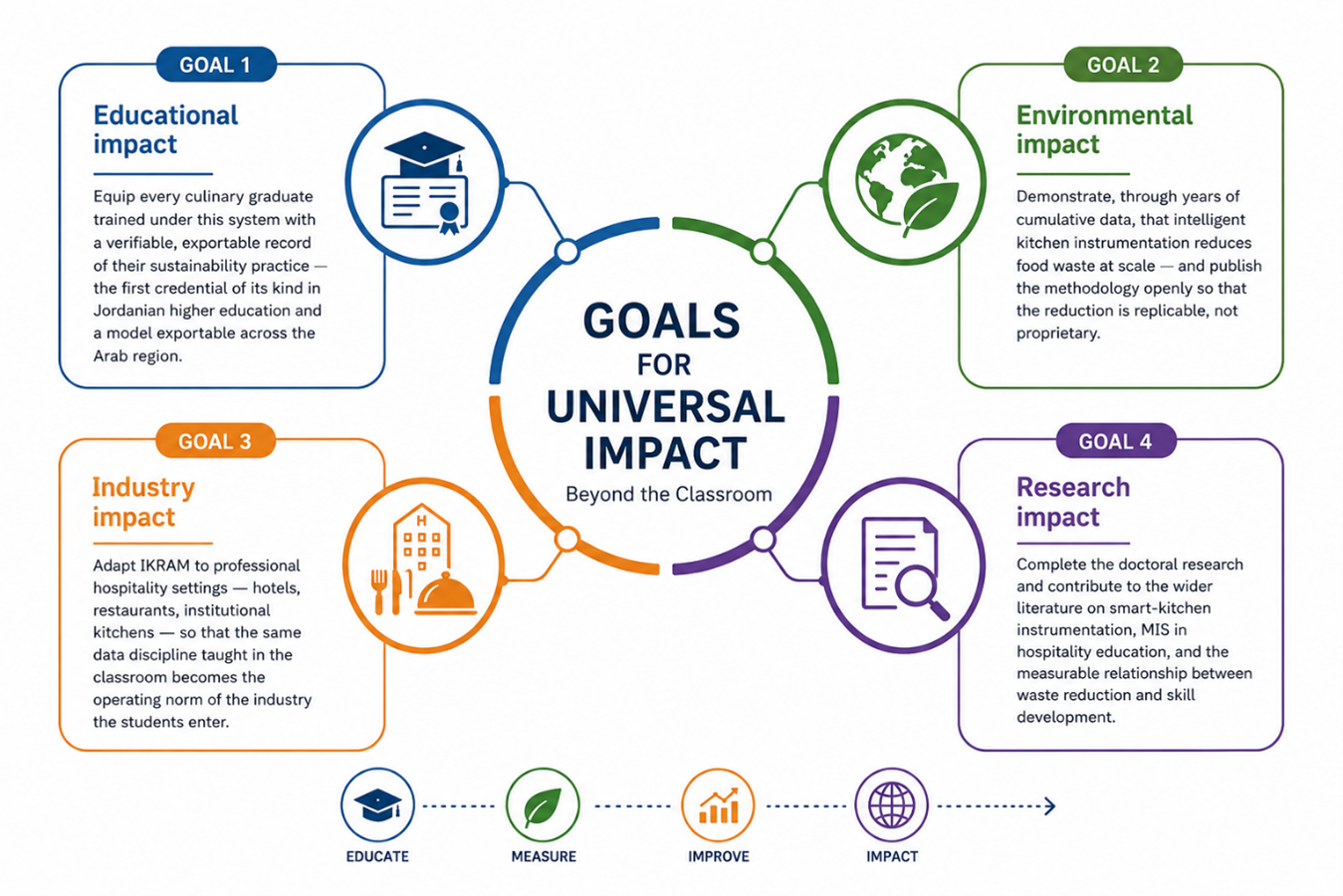
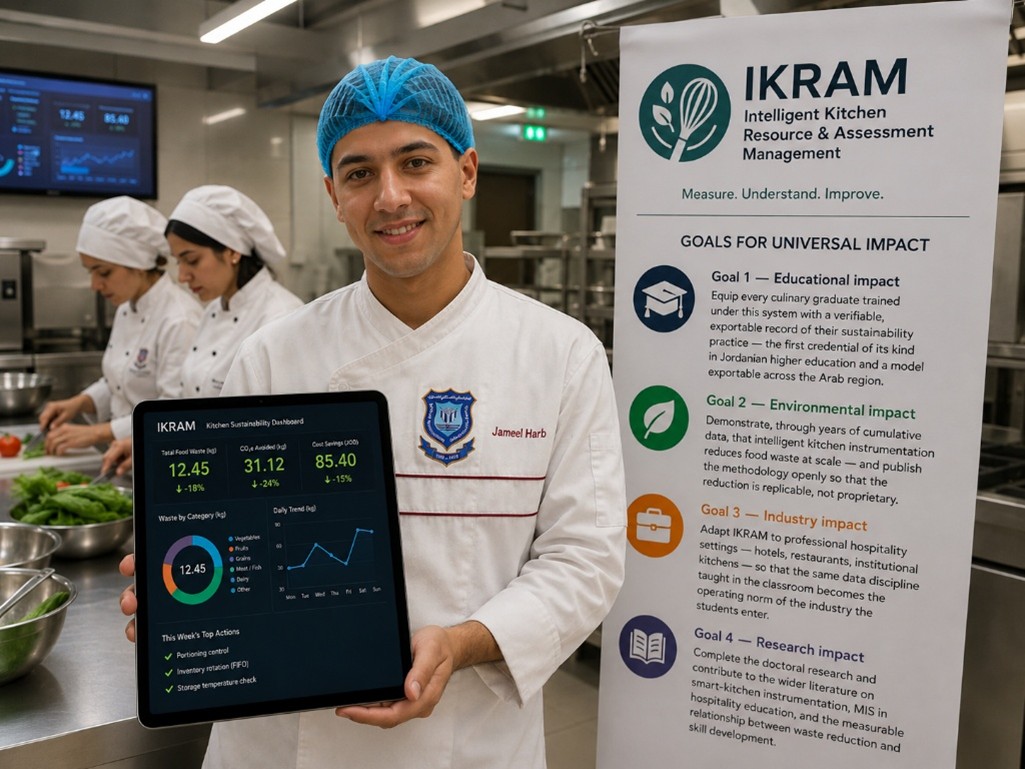
Goals for Universal Impact

Beyond the Classroom

Goal 1

Educational impact. Equip every culinary graduate trained under this system with a verifiable, exportable record of their sustainability practice — the first credential of its kind in Jordanian higher education and a model exportable across the Arab region.

Goal 2

Environmental impact. Demonstrate, through years of cumulative data, that intelligent kitchen instrumentation reduces food waste at scale — and publish the methodology openly so that the reduction is replicable, not proprietary.

Goal 3

Industry impact. Adapt IKRAM to professional hospitality settings — hotels, restaurants, institutional kitchens — so that the same data discipline taught in the classroom becomes the operating norm of the industry the students enter.

Goal 4

Research impact. Complete the doctoral research and contribute to the wider literature on smart-kitchen instrumentation, MIS in hospitality education, and the measurable relationship between waste reduction and skill development.

Goals for Universal Impact infographic

Closing Pledge

What My Students Take With Them

Every student who completes a practical course with Chef Maysaa leaves with three things very few culinary graduates in the region carry: a knife skill, a number-sense for what waste costs in their own currency, and the lived experience of running a kitchen that produces less of it. That is the teaching this candidacy is built on.

"If the next chef I train opens a kitchen in Amman, Riyadh, or anywhere and reduces their food waste by even ten percent, then this classroom did its work."

— Chef Maysaa Hassiba
Student holding IKRAM tablet with goals banner