Implementation · Al-Ahliyya Amman University

IKRAM

Intelligent Waste Management for Culinary Education


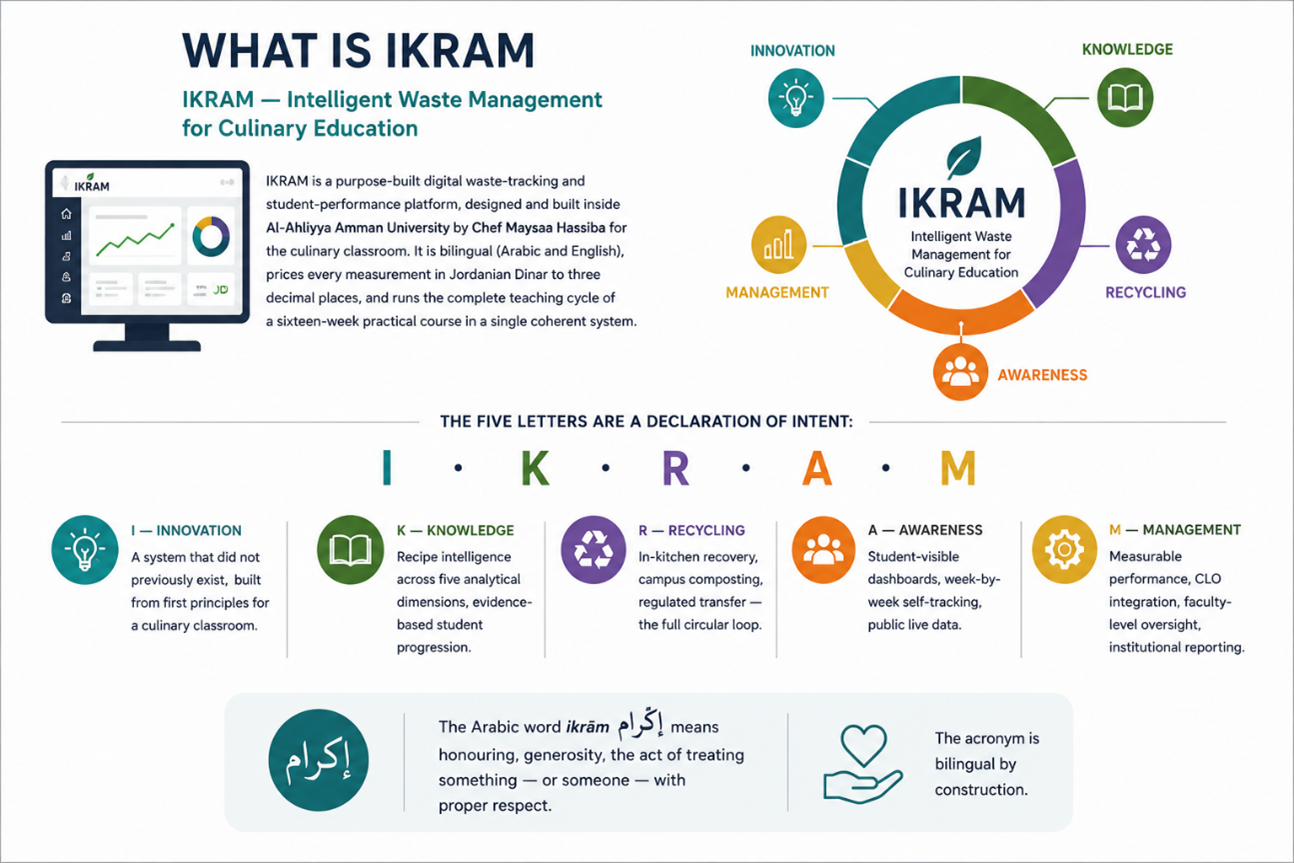
IKRAM is a purpose-built digital waste-tracking and student-performance platform, designed and built inside Al-Ahliyya Amman University by Chef Maysaa Hassiba for the culinary classroom. It is bilingual (Arabic and English), prices every measurement in Jordanian Dinar to three decimal places, and runs the complete teaching cycle of a sixteen-week practical course in a single coherent system.

I
Innovation
A system that did not previously exist, built from first principles for a culinary classroom.
K
Knowledge
Recipe intelligence across five analytical dimensions, evidence-based student progression.
R
Recycling
In-kitchen recovery, campus composting, regulated transfer — the full circular loop.
A
Awareness
Student-visible dashboards, week-by-week self-tracking, public live data.
M
Management
Measurable performance, CLO integration, faculty-level oversight, institutional reporting.
إكرام

The Arabic word ikrām إكرام means honouring, generosity, the act of treating something — or someone — with proper respect. The acronym is bilingual by construction.

What Is IKRAM — full infographic

Areas Covered by IKRAM

Eight Integrated Measurement Areas

⚖️

Ingredient Inventory

Every ingredient logged by weight at session start, with cost and nutritional value pulled from the official AAU purchase plan.

🔪

Waste Measurement

Per-ingredient trimming waste recorded after every knife-skill exercise, by type and weight, for every student.

📊

Student Performance

Individual progression chart for every student across the sixteen-week semester; falling waste percentage = rising skill level.

💰

Cost Tracking

JOD cost to three-decimal accuracy per session, per recipe, per student — sourced from the official purchase plan.

🌍

Carbon Footprint

CO₂ calculation per ingredient per session, cumulative dashboard, live SDG-13 contribution.

♻️

Recovery Pathways

Every by-product classified: in-kitchen processing, campus composting, or JFDA-regulated transfer. Discarding without classification is not permitted.

📚

Recipe Intelligence

Five analytical dimensions per recipe: ingredients, financial, nutrition, carbon footprint, flavour harmony.

🎯

CLO Integration

Performance data flows directly into Course Learning Outcome percentages, making sustainability a graded component of academic assessment.
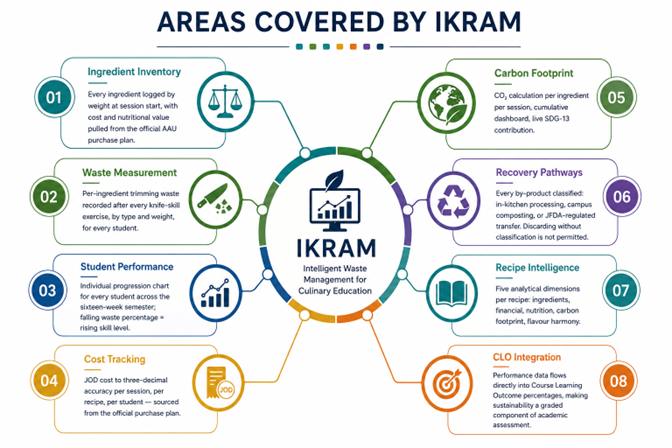
Areas Covered by IKRAM — infographic

Intelligent Recipe Engine

From Ingredients to Plate — Before Cooking Even Begins

IKRAM does not only measure waste after production — it actively guides decision-making before cooking even begins. Using the ingredients currently logged in inventory, whether from the official AAU purchase plan or recovered surplus, the system recommends recipes that can be prepared immediately, calculates exact portion quantities, displays the complete nutritional profile, and computes the precise commercial cost per portion in Jordanian Dinar before any ingredient is processed.

🤖

AI Recipe Suggestion

IKRAM analyses available inventory and automatically suggests recipes the kitchen can prepare immediately. The system matches current stock and recovered ingredients with recipes already structured in the platform, ranking options by usability, waste-reduction potential, and production efficiency. Helps answer: "What can we produce with the ingredients we already have?"

🧮

Perfect Portioning

Once a recipe is selected, IKRAM automatically scales ingredient quantities to the required number of portions. Whether preparing five plates or a full cohort, the system calculates exact quantities instantly, reducing overproduction, shortages, and unnecessary waste before preparation begins.

🥗

Full Nutritional Profile

For every recipe and portion size, IKRAM generates a full nutritional profile including calories, macronutrients, and micronutrients. Students can evaluate the nutritional impact of a dish before cooking, linking culinary practice with nutrition literacy.

💵

Potential Price per Portion

IKRAM calculates the live commercial cost of every recipe using official purchase-plan pricing data. Ingredient costs are broken down individually and totalled automatically per portion in Jordanian Dinar to three-decimal accuracy, helping students understand the financial realities of professional kitchens.


Why This Matters Pedagogically

Recipe generation becomes the first stage of waste reduction. By recommending dishes based on ingredients already available in inventory and scaling them to exact portion requirements, IKRAM reduces unnecessary overproduction before preparation even begins. The system closes the sustainability loop both upstream — deciding what to cook — and downstream — determining how recoverable waste is reused.

Recipe selection, portion sizing, nutritional analysis, and cost-per-plate are presented together within a single workflow — mirroring the real decision-making process of a professional kitchen. IKRAM trains students not only in culinary technique, but in the operational thinking required for modern food production.

How IKRAM Works

The Six-Step Protocol

1

Log Inventory and Ingredients

At the start of each session, students log all ingredients by weight into the system. IKRAM automatically calculates inventory availability, nutritional values, and ingredient costs using the official AAU purchase plan.

2

Generate Recipes and Portion Calculations

Using the ingredients currently available in inventory, IKRAM suggests recipes the kitchen can prepare immediately. The system automatically calculates exact portion quantities, nutritional profiles, and live cost-per-portion to reduce overproduction before preparation begins.

3

Record Waste and Yield

During preparation tasks, students record peeling waste, trimming waste, and usable yield for every ingredient. IKRAM measures waste percentages, yield accuracy, and technical skill development in real time.

4

Recover Reusable Products

Recoverable trimmings are processed into reusable products such as stock powders, spice blends, pickles, jams, and ferments. Recovered products are returned to inventory and become available for future recipe generation.

5

Compost and Regulated Transfer

Organic material unsuitable for recovery is separated for composting on campus. Remaining by-products are sorted, logged, and transferred according to Jordan Food and Drug Administration regulations.

6

Update Progression and Sustainability Records

At the end of each session, IKRAM updates the student's progression chart, CLO achievement, and sustainability performance. The system builds an exportable professional portfolio that documents waste reduction, technical development, recovery practices, and operational decision-making across the semester.

What IKRAM Produces

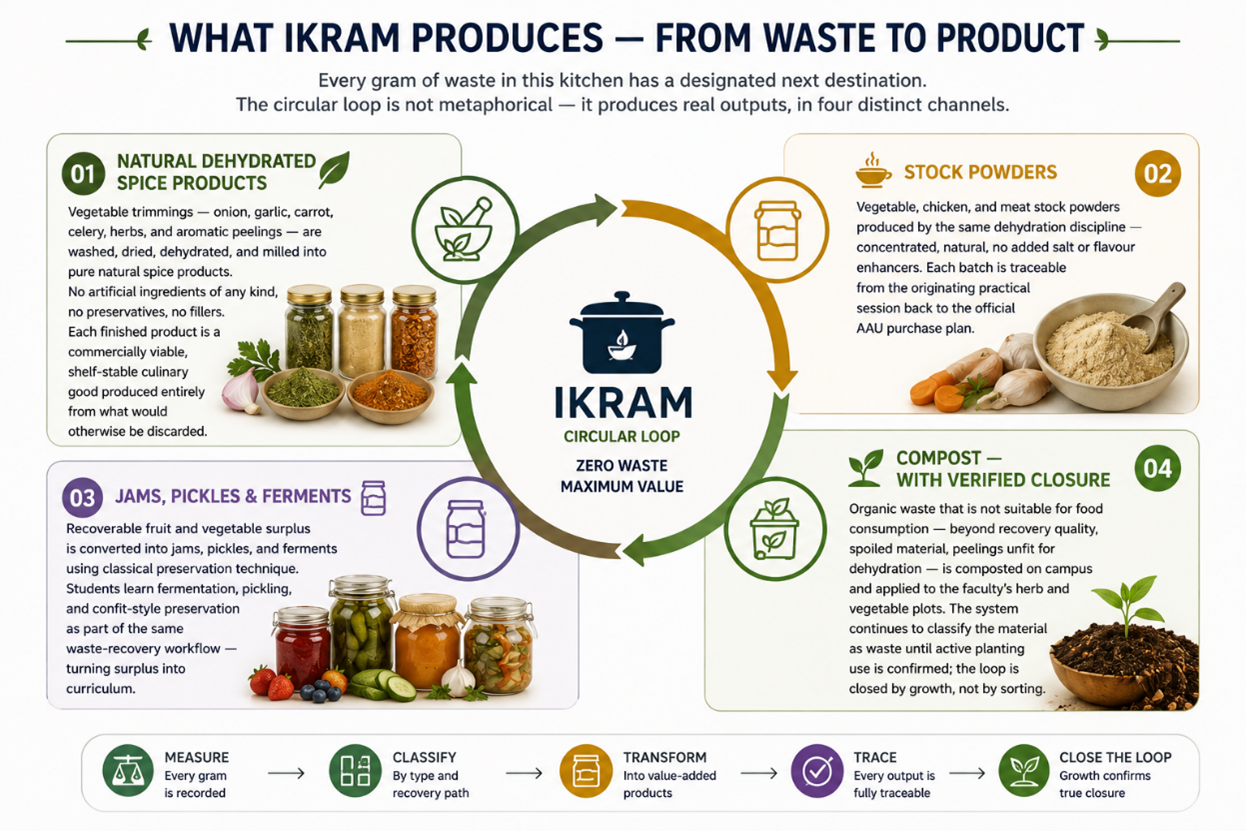
From Waste to Product — Four Recovery Channels

Every gram of waste in this kitchen has a designated next destination. The circular loop is not metaphorical — it produces real outputs, in four distinct channels.

🌿

Natural Dehydrated Spice Products

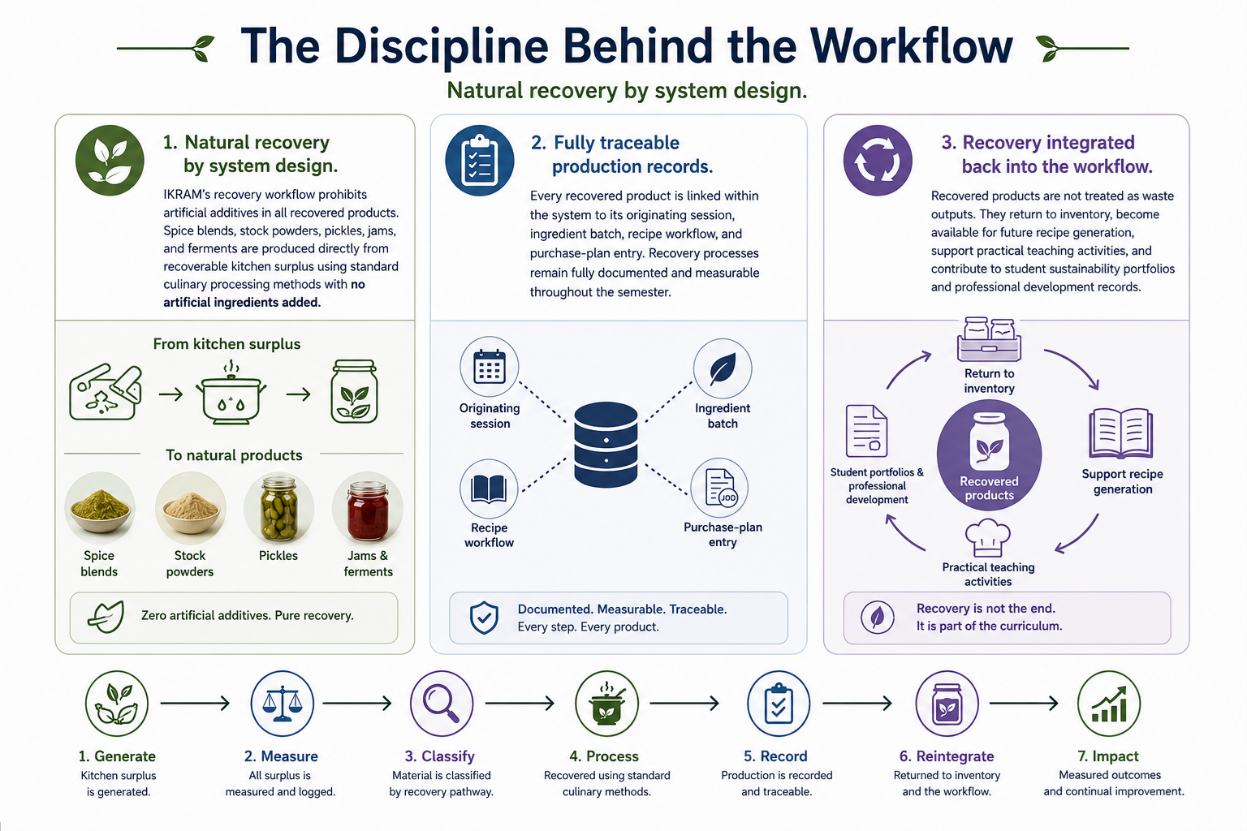
Vegetable trimmings — onion, garlic, carrot, celery, herbs, and aromatic peelings — are washed, dried, dehydrated, and milled into pure natural spice products. No artificial ingredients of any kind, no preservatives, no fillers. Each finished product is a commercially viable, shelf-stable culinary good produced entirely from what would otherwise be discarded.

🍲

Stock Powders

Vegetable, chicken, and meat stock powders produced by the same dehydration discipline — concentrated, natural, no added salt or flavour enhancers. Each batch is traceable from the originating practical session back to the official AAU purchase plan.

🫙

Jams, Pickles & Ferments

Recoverable fruit and vegetable surplus is converted into jams, pickles, and ferments using classical preservation technique. Students learn fermentation, pickling, and confit-style preservation as part of the same waste-recovery workflow — turning surplus into curriculum.

🌱

Compost — With Verified Closure

Organic waste not suitable for food consumption is composted on campus and applied to the faculty's herb and vegetable plots. The system continues to classify the material as waste until active planting use is confirmed; the loop is closed by growth, not by sorting.

From Waste to Product — circular loop infographic
The Discipline Behind the Workflow infographic

The Five Analytical Dimensions of Every Recipe

One Recipe, Five Operational Layers

01

Inventory and Ingredients

Every recipe is generated from ingredients currently available in inventory, including official purchase-plan stock and recovered products. Ingredient weight, availability, and usage are tracked automatically in real time.

02

Financial Analysis

IKRAM calculates ingredient cost, cost-per-portion, and total recipe cost in Jordanian Dinar to three-decimal accuracy, connecting every production decision to real commercial kitchen operations.

03

Nutritional Profile

Each recipe includes a complete nutritional breakdown per portion, including calories, macronutrients, and micronutrients, integrating nutrition literacy directly into culinary practice.

04

Waste and Recovery Performance

The system measures usable yield, peeling waste, trimming waste, and recovery potential for every recipe session. Recoverable by-products are redirected into reusable products or compost workflows.

05

Technical and Sustainability Progression

Every session contributes to the student's progression chart, tracking technical development, waste reduction, CLO achievement, and sustainability performance across the semester.

Five Analytical Dimensions of Every Recipe — infographic

Data Integrity

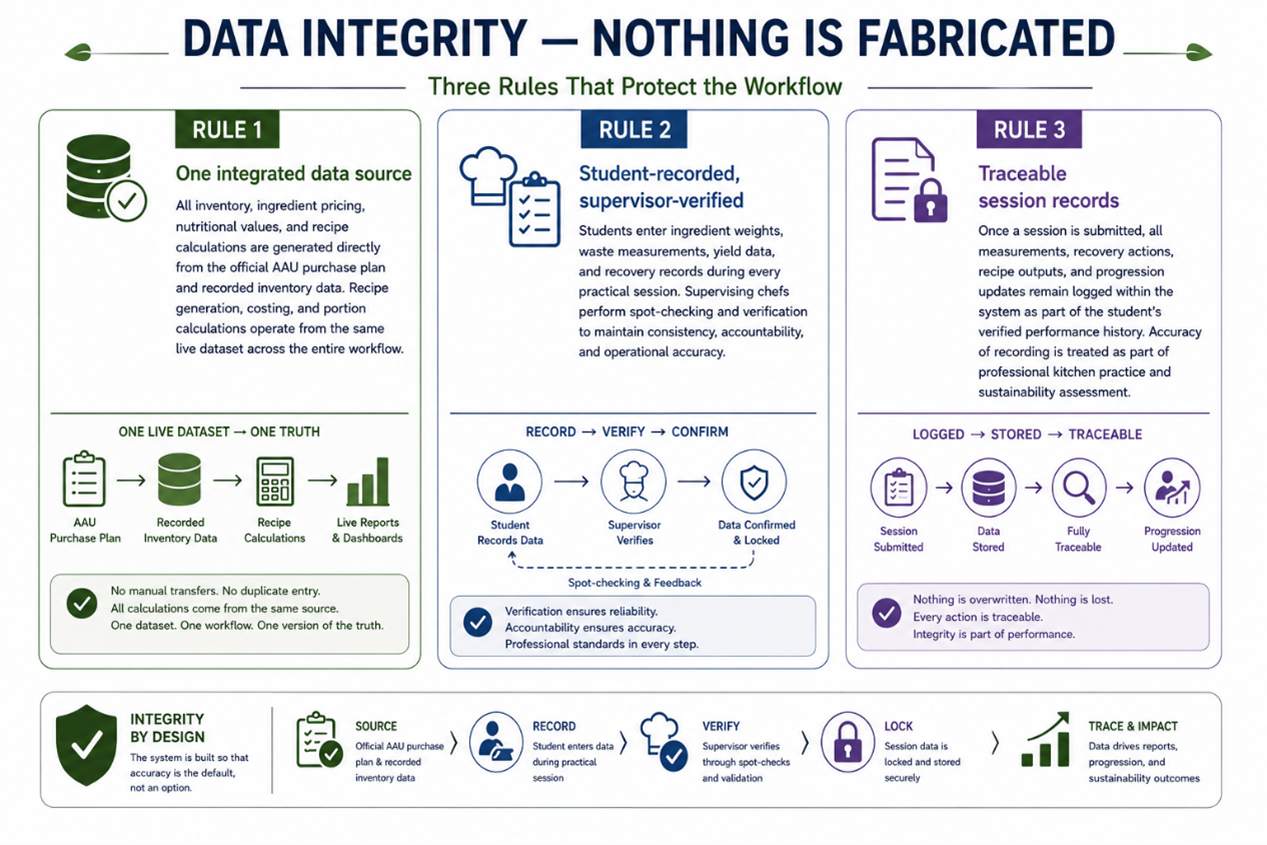
Nothing Is Fabricated — Three Rules That Protect the Workflow

1

One integrated data source

All inventory, ingredient pricing, nutritional values, and recipe calculations are generated directly from the official AAU purchase plan and recorded inventory data. Recipe generation, costing, and portion calculations operate from the same live dataset across the entire workflow.

2

Student-recorded, supervisor-verified

Students enter ingredient weights, waste measurements, yield data, and recovery records during every practical session. Supervising chefs perform spot-checking and verification to maintain consistency, accountability, and operational accuracy.

3

Traceable session records

Once a session is submitted, all measurements, recovery actions, recipe outputs, and progression updates remain logged within the system as part of the student's verified performance history. Accuracy of recording is treated as part of professional kitchen practice and sustainability assessment.

Data Integrity — Nothing Is Fabricated infographic

Inside a Single Lecture

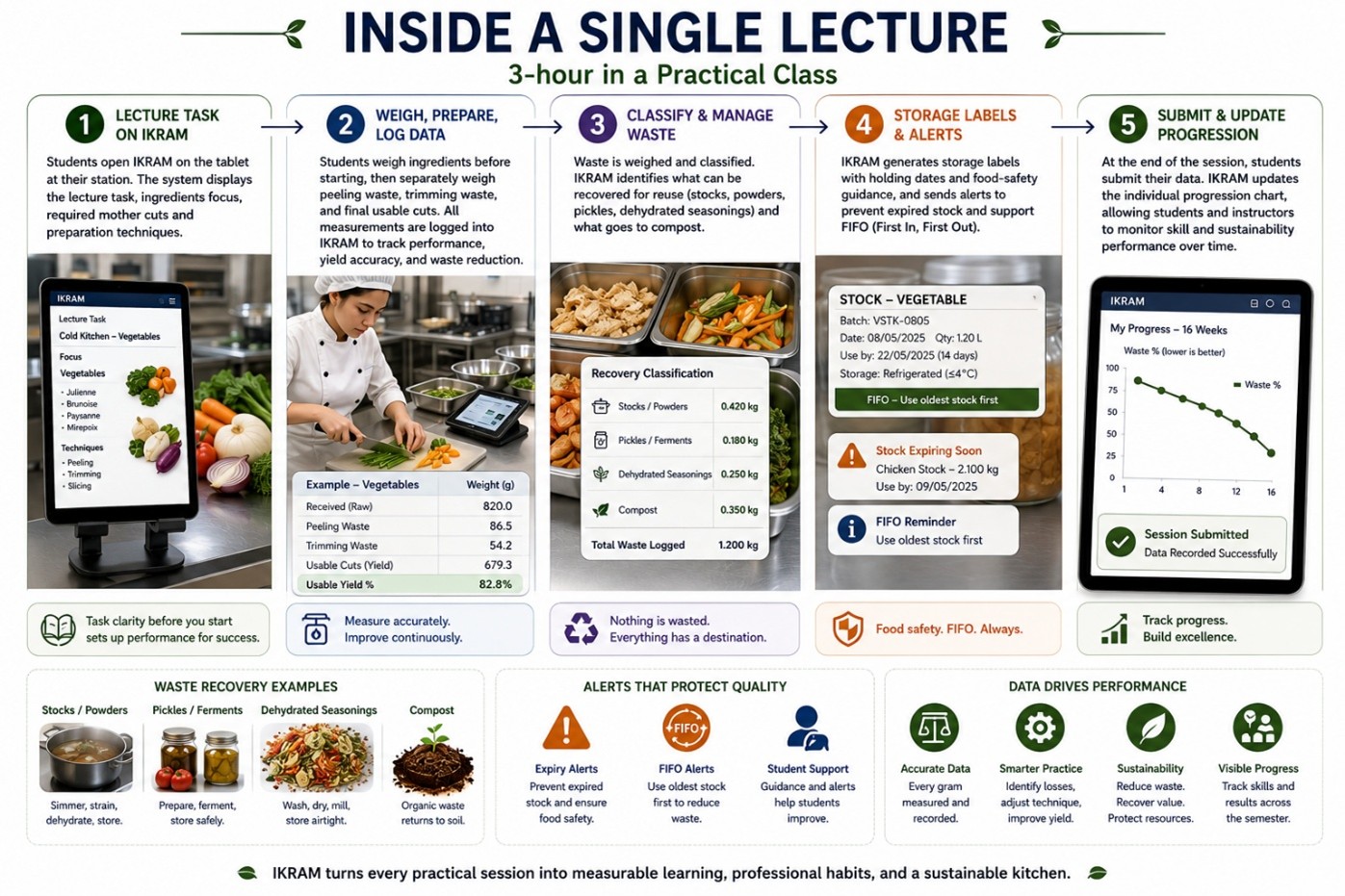
3 Hours in a Practical Class — How IKRAM Guides Practice Continuously

Students enter the Cold Kitchen class and open the IKRAM application on the tablet at their station. The system displays the lecture task, which may focus on vegetables, fruits, chicken, meat, or seafood, along with the required mother cuts and preparation techniques.

Students weigh the ingredients they receive before starting, then separately weigh the peeling waste, trimming waste, and final usable cuts produced during the exercise. These measurements are logged into IKRAM to track each student's technical performance, yield accuracy, and waste reduction throughout the semester.

The system also weighs and classifies waste by identifying what can be recovered for reuse — such as stocks, powders, pickles, or dehydrated seasonings — and what should be sent directly to compost. IKRAM automatically generates storage labels with suitable holding dates and food-safety guidance, while sending alerts to prevent expired stock and support the FIFO (First In, First Out) storage approach.

At the end of the session, students submit their data, and the system updates their individual progression chart, allowing both students and instructors to monitor skill development and sustainability performance over time.


How IKRAM Guides Practice — Continuously, Not Just at Assessment

Visible at the start of every session. Before the student touches a knife, her dashboard shows her last three sessions, her current trend, and the specific ingredient category where she is losing the most weight.

CLO tracking, automatic. Each Course Learning Outcome for A1411213 is mapped to a measurable behaviour IKRAM captures. CLO percentages are computed continuously from session data — never reconstructed retrospectively from grade books.

PLO traceability, automatic. CLO data aggregates into Programme Learning Outcome reporting at semester end. The faculty can demonstrate, with a per-student, per-session, per-semester audit trail, that its graduates exit with the competencies the programme claims.

Intervention before it is too late. Underperforming students are flagged in Weeks 5–8, not at the final exam. There is still half a semester in which to correct course — and IKRAM gives the instructor the data to know exactly which adjustment to suggest.

Inside a Single Lecture — 5-step classroom flow infographic

The Student Journey

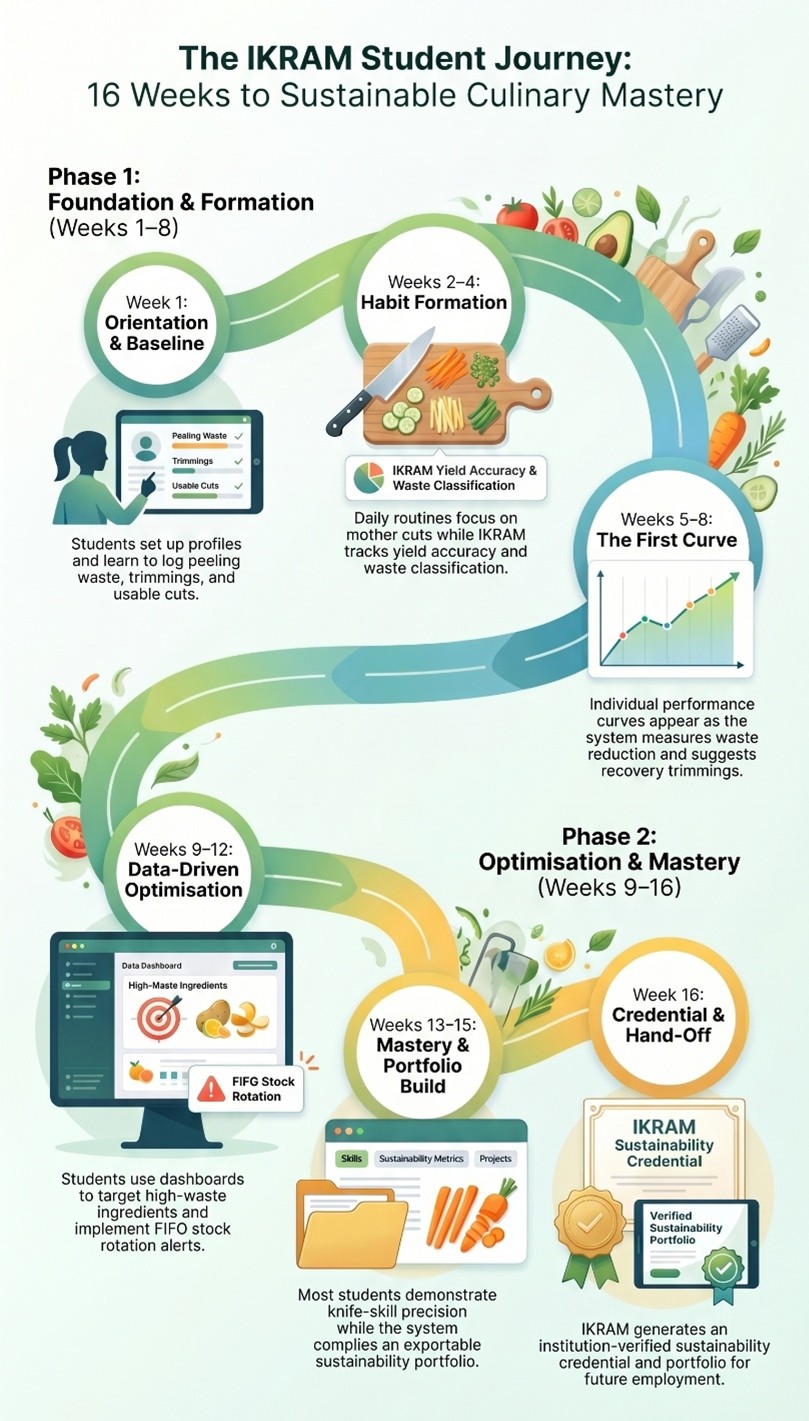
Sixteen Weeks Through IKRAM

WEEK 1

Orientation & Baseline

Students enter the Cold Kitchen, complete their first login, set up their profile, and receive an IKRAM walkthrough. They learn how to weigh ingredients, peeling waste, trimming waste, and usable cuts while logging all data into the system. The dashboard, sixteen-week progression chart, CLO targets, and PLO mapping are introduced from the first session.

WEEKS 2–4

Habit Formation

Students begin the routine of weighing, practising, recording, and submitting data during every practical session. Tasks focus on mother cuts and preparation techniques for vegetables, fruits, meat, chicken, and seafood. IKRAM starts tracking waste percentages, yield accuracy, and technical development. The system also classifies waste into reusable products or compost streams.

WEEKS 5–8

First Curve Appears

Individual performance curves begin to appear as the system measures reductions in waste and improvements in usable yield. Students receive contextual suggestions for recovering trimmings into stocks, powders, pickles, ferments, or dehydrated seasonings. Instructors receive alerts for students requiring additional support. Mid-semester CLO progress is calculated automatically from recorded data.

WEEKS 9–12

Optimisation & Best Practice

Students use their dashboards to identify ingredients generating the highest waste and adjust techniques accordingly. IKRAM generates storage labels with holding dates and food-safety guidance while sending expiry alerts to support FIFO stock rotation. Students achieving professional benchmarks are guided toward advanced recovery and sustainability tasks.

WEEKS 13–15

Mastery & Portfolio Build

By this stage, most students demonstrate measurable reductions in waste and stronger knife-skill precision. IKRAM begins compiling an exportable sustainability portfolio containing progression charts, recovery practices, waste-management performance, and CLO/PLO achievement evidence.

WEEK 16

Credential & Hand-Off

Students submit their final session data. IKRAM finalises the sixteen-week progression chart, computes final CLO percentages from recorded performance data, updates PLO attainment, and generates an institution-verified sustainability credential and portfolio for future employment and professional development.

The IKRAM Student Journey — 16 Weeks to Sustainable Culinary Mastery

SDG Coverage — Operational Contributions

Six United Nations Sustainable Development Goals

IKRAM contributes to six United Nations Sustainable Development Goals. Each contribution below is named together with the specific operational mechanism inside the system that delivers it — not a general claim, but the concrete process.

SDG 2
Zero Hunger

Zero Hunger

Recoverable vegetable, fruit, and protein trimmings are redirected into reusable food products such as stock powders, spice blends, jams, pickles, and ferments. Recovered products return to inventory for future recipe generation and practical teaching use, reducing food loss while maximizing ingredient utilization.

SDG 4
Quality Education

Quality Education

Sustainability is embedded directly into practical culinary education as a measurable and trackable learning outcome. Every kitchen session generates performance data linked to waste reduction, technical skill development, CLO achievement, and professional sustainability practice. Students graduate with an exportable, institution-verified sustainability portfolio documenting sixteen weeks of measurable progression.

SDG 8
Decent Work

Decent Work & Economic Growth

IKRAM develops operational, financial, sustainability, and data-literacy skills aligned with modern hospitality industry requirements. Students learn recipe costing, inventory control, portion management, waste reduction, and recovery workflows within real kitchen production environments.

SDG 12
Responsible Consumption

Responsible Consumption & Production

The entire IKRAM workflow is structured around controlled ingredient usage, waste prevention, recovery, composting, and regulated disposal. Every by-product generated during practical sessions must be classified within the system as reusable recovery, compostable material, or regulated transfer, creating a fully traceable circular production model.

SDG 13
Climate Action

Climate Action

By reducing overproduction, improving usable yield, and recovering surplus ingredients, IKRAM lowers avoidable food waste within kitchen operations. The system builds sustainability awareness directly into daily culinary decision-making through inventory control, recovery workflows, and responsible production practices.

SDG 17
Partnerships

Partnerships for the Goals

IKRAM was developed through collaboration between hospitality education, business, and operational digital systems within AAU and Movenpick Hotels and Resorts in Jordan. The workflow also connects teaching kitchens with regulated waste-transfer processes, sustainability practices, and broader community and professional development initiatives.

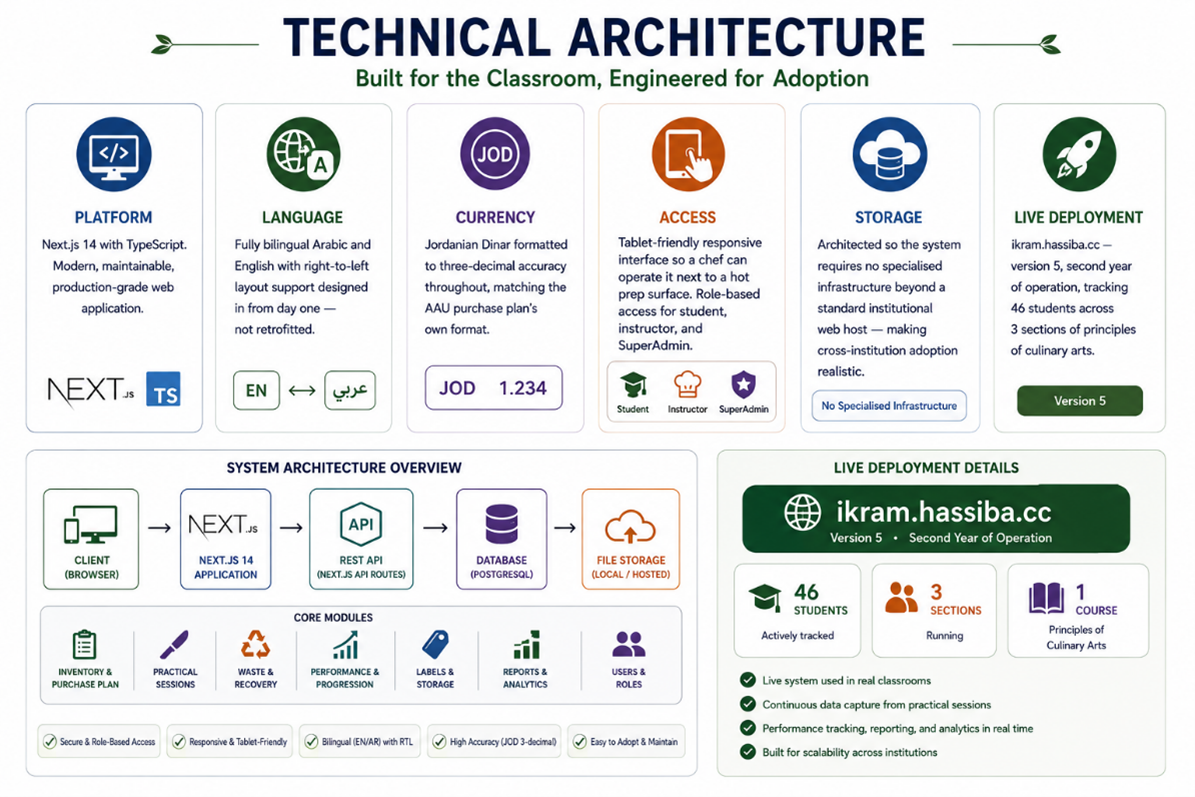
Technical Architecture

Built for the Classroom, Engineered for Adoption

Platform

Next.js 14 with TypeScript. Modern, maintainable, production-grade web application.

Language

Fully bilingual Arabic and English with right-to-left layout support designed in from day one — not retrofitted.

Currency

Jordanian Dinar formatted to three-decimal accuracy throughout, matching the AAU purchase plan's own format.

Access

Tablet-friendly responsive interface so a chef can operate it next to a hot prep surface. Role-based access for student, instructor, and SuperAdmin.

Storage

Architected so the system requires no specialised infrastructure beyond a standard institutional web host — making cross-institution adoption realistic.

Live Deployment

ikram.hassiba.cc — version 5, second year of operation, tracking 46 students across 3 sections of principles of culinary arts.

Technical Architecture — Built for the Classroom, Engineered for Adoption

Versions — Five Iterations of Reflective Practice

How the System Learned From the Classroom

v1 · Mar 2025

Proof of Concept

Lesson: students engage more deeply with sustainability when their own waste is visible to them, not just to the instructor.

v2

Per-Student Measurement Added

Lesson: aggregate waste hides individual learning curves; tailored intervention needs individual data.

v3

Cost and Carbon Layer Integrated

Lesson: students respond to JOD before they respond to grams; multi-unit feedback drives behaviour change.

v4

Reprocessing and Circular-Loop Tracking

Lesson: measuring waste is not enough — students must close the loop themselves, or the lesson does not transfer.

v5 · Mar 2026

Full Institutional System

Lesson: a tool that lives only in one teacher's classroom cannot change a curriculum; the platform had to be ready for adoption beyond its author.

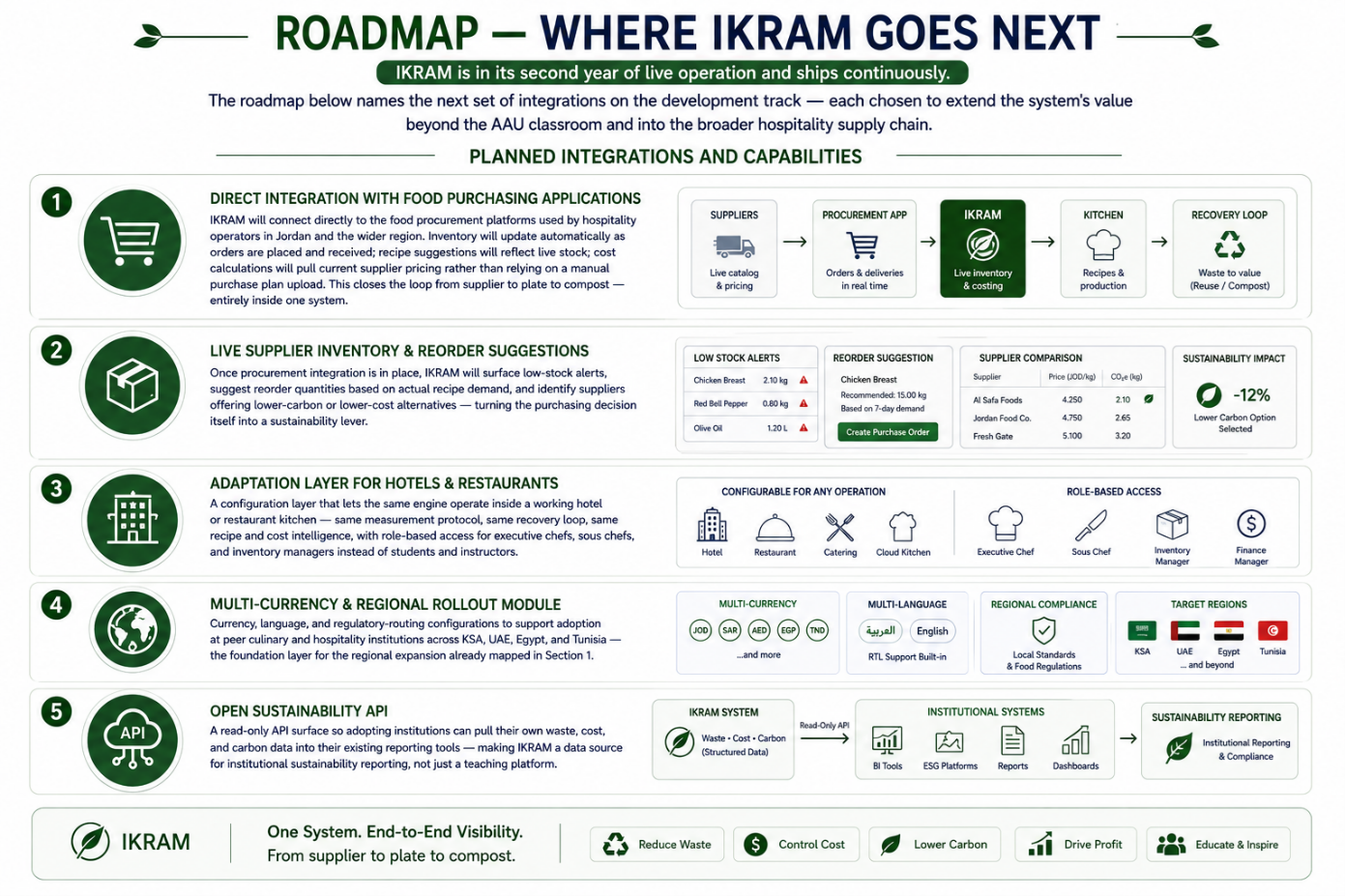
Roadmap — Where IKRAM Goes Next

Planned Integrations and Capabilities

IKRAM is in its second year of live operation and ships continuously. The roadmap below names the next set of integrations on the development track — each chosen to extend the system's value beyond the AAU classroom and into the broader hospitality supply chain.

🛒

Direct Integration with Food Purchasing Applications

IKRAM will connect directly to the food procurement platforms used by hospitality operators in Jordan and the wider region. Inventory will update automatically as orders are placed and received; recipe suggestions will reflect live stock; cost calculations will pull current supplier pricing rather than relying on a manual purchase plan upload. This closes the loop from supplier to plate to compost — entirely inside one system.

📦

Live Supplier Inventory & Reorder Suggestions

Once procurement integration is in place, IKRAM will surface low-stock alerts, suggest reorder quantities based on actual recipe demand, and identify suppliers offering lower-carbon or lower-cost alternatives — turning the purchasing decision itself into a sustainability lever.

🏨

Adaptation Layer for Hotels & Restaurants

A configuration layer that lets the same engine operate inside a working hotel or restaurant kitchen — same measurement protocol, same recovery loop, same recipe and cost intelligence, with role-based access for executive chefs, sous chefs, and inventory managers instead of students and instructors.

🌍

Multi-Currency & Regional Rollout Module

Currency, language, and regulatory-routing configurations to support adoption at peer culinary and hospitality institutions across KSA, UAE, Egypt, and Tunisia — the foundation layer for the regional expansion already mapped in Section 1.

📈

Open Sustainability API

A read-only API surface so adopting institutions can pull their own waste, cost, and carbon data into their existing reporting tools — making IKRAM a data source for institutional sustainability reporting, not just a teaching platform.

Roadmap — Where IKRAM Goes Next infographic

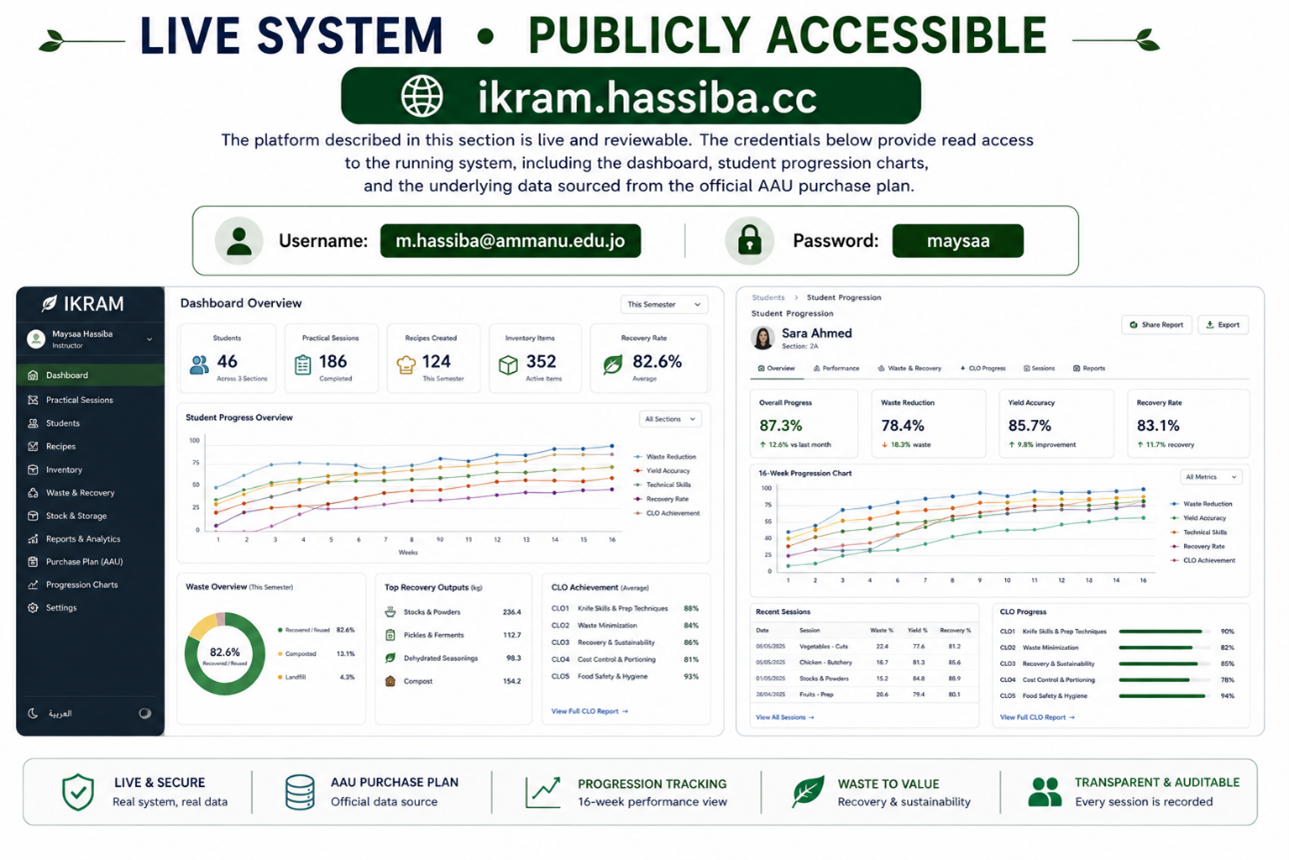
Live System — Review Access

Live System · Publicly Accessible

The platform described in this section is live and reviewable. The credentials below provide read access to the running system, including the dashboard, student progression charts, and the underlying data sourced from the official AAU purchase plan.

Live & Publicly Accessible

ikram.hassiba.cc

Version 5 · Second year of operation · 46 students · 3 sections · Principles of Culinary Arts

Username
m.hassiba@ammanu.edu.jo
Password
maysaa
IKRAM Live System — Dashboard and Student Progression